


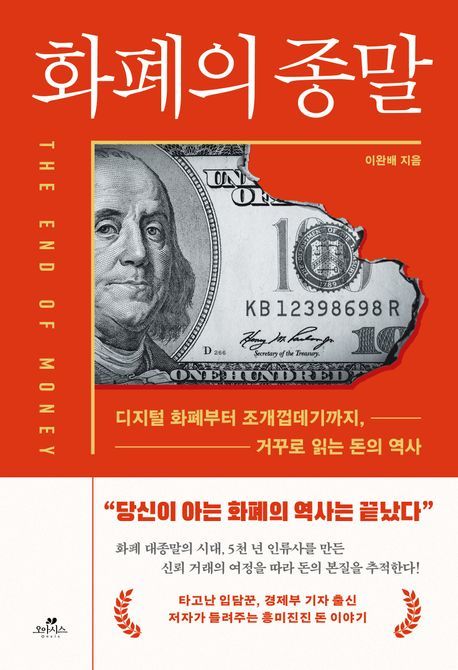
The End of Money: Exploring currency's essence in the digital age
Translated from Korean, summarized and contextualized by DistantNews.
At a glance
In-depth
Sources not specified
Context piece
- A new book, "The End of Money," by former economics reporter Lee Wan-bae explores the essence of currency in an era dominated by Bitcoin and electronic payments.
- The book traces 5,000 years of monetary history, examining how the meaning and value of currency have evolved from ancient shells to modern digital assets.
- It challenges conventional views on money, highlighting its role in building relationships and conveying emotions, not just as a medium of exchange.
In an age where Bitcoin and electronic payments are becoming commonplace, the very concept of traditional money is being questioned. A new book, "The End of Money" (화폐의 종말), authored by former economics reporter Lee Wan-bae, delves into the fundamental nature of currency and contemplates its future.
The book embarks on a 5,000-year journey through the history of money, examining 15 distinct forms of currency. It meticulously traces the evolution of monetary meaning and value, from the cowrie shells of prehistoric times to the gold standard of 19th-century Europe and the digital realm of Bitcoin today. Lee, who has previously authored popular books like "Why Is Instagram Free?" and "The Dark History of Economic Wars," draws upon his extensive experience to present this historical narrative in an accessible style.
"The End of Money" revisits the stories of various currencies from around the world that have faded into obscurity, such as the "silverless silver coin" used in the Roman Empire in the 3rd century and the "Dangbaekjeon" (當百錢) issued in Joseon Dynasty Korea during the 19th century. The book posits that each new form of currency that emerged to replace old ones simultaneously created new systems and structures.
Beyond its function as a medium of exchange, the book argues that money has historically served as a tool for building relationships between people and a channel for conveying emotions. It encourages readers to reconsider their conventional perspectives on money and its multifaceted roles in society. The publication aims to provoke thought on what money truly is and what it should become in the future.
DistantNews Editorial
Originally published by Dong-A Ilbo in Korean. Translated, summarized, and contextualized by our editorial team with added local perspective. Read our editorial standards.
More Stories


From Our Blog

What Gets Lost (and Found) When News Is Translated

The Critical Role of Diaspora Media in Global News

What Travellers Should Know About Countries with Restricted Press

A Digital Nomad's Guide to Following Local News

How the Same Story Looks Different in Different Countries
