


The paradox of 'big players': Scale doesn't match adaptability
Translated from Vietnamese, summarized and contextualized by DistantNews.
At a glance
News
Named sources
New plan
- A report indicates that Vietnamese businesses are only 58% ready for practical AI application, facing significant thought barriers.
- Mid-sized companies (500-1,000 employees) show higher readiness (68.7 points) than large enterprises (61.5 points), challenging the assumption that size equals capability.
- The primary obstacle for Vietnamese businesses is translating strategy into action, with slow execution being a key challenge, and middle management identified as the weakest link.
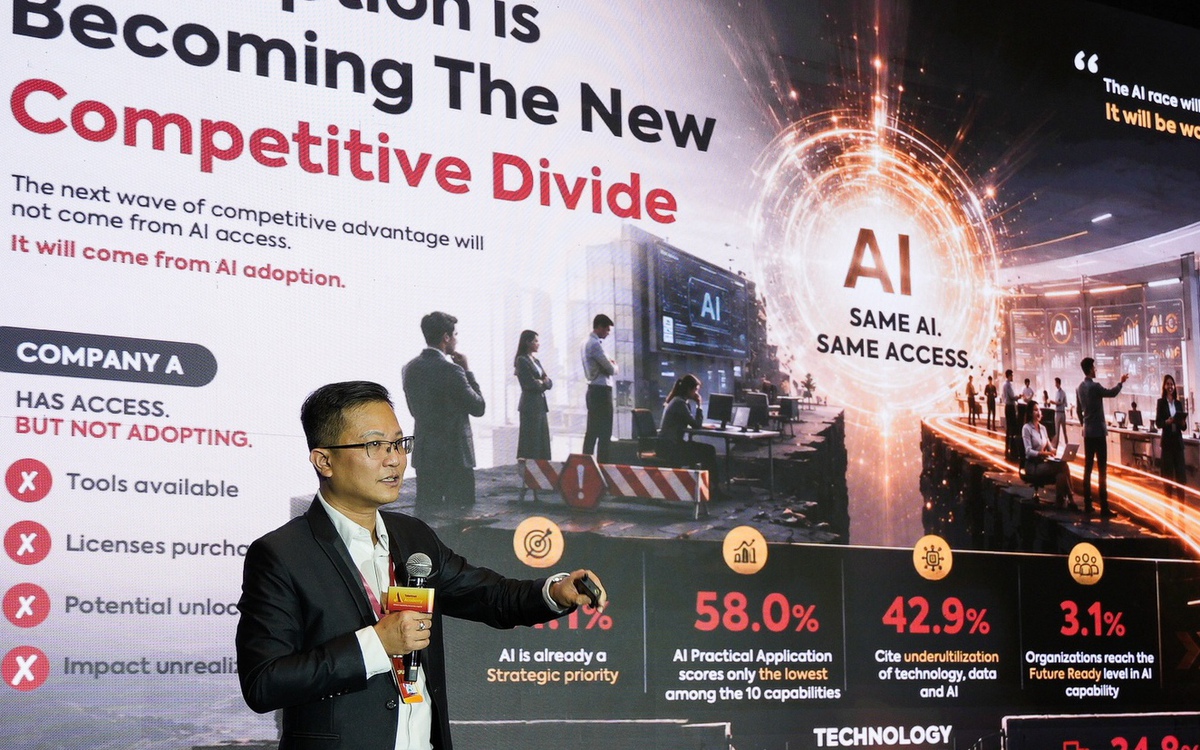
Vietnamese businesses are demonstrating a notable paradox: while their scale often creates market presence, their actual adaptability and readiness for new technologies lag significantly. A report by Talentnet Academy reveals that the average readiness score for practical AI application among Vietnamese companies stands at a mere 58 out of 100, placing them in the "developing" category.
The biggest bottleneck for Vietnamese businesses today is the ability to convert strategy into action.
Interestingly, mid-sized enterprises, with workforces between 500 and 1,000 employees, exhibit a higher readiness score of 68.7 points compared to large corporations, which scored 61.5 points. Experts attribute this to a crucial distinction: capability is not an automatic outcome of growth but a result of deliberate system design. Many large firms risk a breakdown in execution as their internal "operating systems" fail to keep pace with their expansion.
The most significant bottleneck identified is the difficulty Vietnamese companies face in converting strategy into concrete actions, with 37.3% citing slow implementation as a major business challenge. Furthermore, 67.7% of businesses pinpoint middle management as the weakest link in their capability chain. This crucial layer, responsible for replicating strategic execution, often lacks the necessary leadership and coaching skills to bridge the gap between strategy and daily operations.
Middle management is the weakest link in the system of capabilities.
During a growth equation seminar, Dr. Le Mai Lan, Vice Chairwoman of Vingroup and President of VinUni University, shared insights on execution challenges within her conglomerate. She emphasized the importance of a systemic mindset, seeing opportunities within pressure. Vingroup employs a "50/50" rule, cutting meeting times and participants by half and requiring proposals to fit on a single page, promoting simplicity amidst complexity.
The advantage of leadership lies in systemic thinking – seeing opportunities even in pressure.
Nguyen Thi Bich Van, CEO of Unilever Vietnam, highlighted speed as vital in the fast-moving consumer goods sector, stressing that leaders must drive trends rather than just follow them. She advocates for leaders to exemplify learning by engaging directly with data and coding to spearhead digital transformation. Kim Le Huy, CEO of DKSH Vietnam, believes that while Vietnam offers vast opportunities, realizing their value hinges on leadership's trust in their teams, proposing a "two-handed leadership" model that balances operations with adaptability.
Leaders must build the capacity for learning and innovation within the organization.
DistantNews Editorial
Originally published by Tuổi Trẻ in Vietnamese. Translated, summarized, and contextualized by our editorial team with added local perspective. Read our editorial standards.
More Stories


From Our Blog

What Gets Lost (and Found) When News Is Translated

The Critical Role of Diaspora Media in Global News

What Travellers Should Know About Countries with Restricted Press

A Digital Nomad's Guide to Following Local News

How the Same Story Looks Different in Different Countries
