


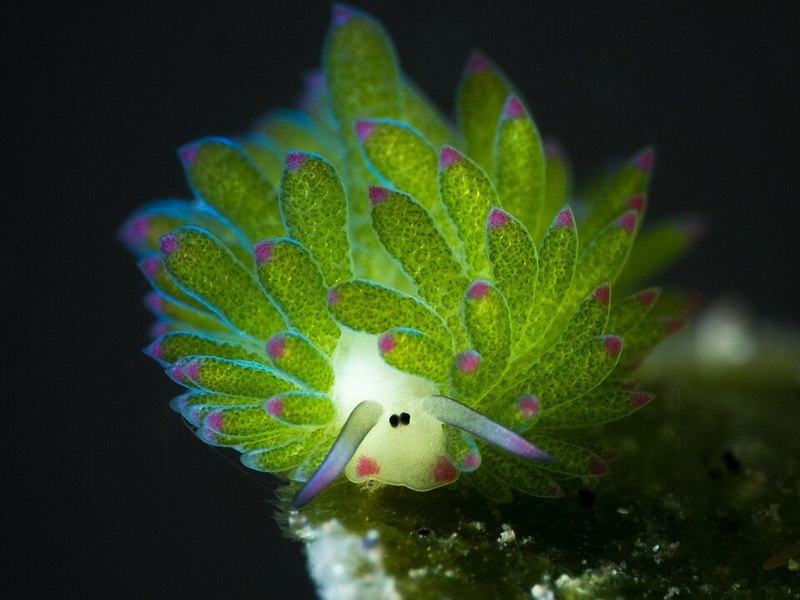
The 'Sea Sheep': Tiny Sea Slug That 'Eats' Light Through Photosynthesis
Translated from Romanian, summarized and contextualized by DistantNews.
At a glance
In-depth
Sources not specified
Context piece
- The Costasiella kuroshimae, or 'sea sheep,' is a tiny sea slug that can produce energy through photosynthesis.
- It achieves this by retaining chloroplasts from the algae it consumes, a process called kleptoplasty.
- These sea slugs inhabit tropical waters in the Pacific and Indian Oceans and play a role in marine ecosystem balance.
A minuscule sea slug, no larger than a grain of rice, is captivating scientists with its remarkable ability to harness solar power. Known as Costasiella kuroshimae, or the 'sea sheep,' this creature possesses a unique survival strategy: it partially produces its own energy through photosynthesis.
Found in the shallow tropical waters of the western Pacific and eastern Indian Oceans, including regions like Japan, Indonesia, and the Philippines, the sea sheep belongs to the Sacoglossa group of sea slugs. These slugs feed on algae, but instead of fully digesting their meal, they ingeniously retain the chloroplasts – the cellular powerhouses responsible for photosynthesis – within their own bodies. This extraordinary process, termed kleptoplasty, makes them one of the few known animals capable of benefiting directly from sunlight.
The chloroplasts are housed in leaf-like appendages on the slug's back, where they continue to convert sunlight into energy for days. These structures also serve as camouflage, their green hue blending seamlessly with the algae they inhabit. Researchers speculate these appendages might also contain chemical defenses against predators. Two ear-like structures called rhinophores, located above its eyes, help the sea slug detect chemicals in the water, aiding in navigation and food location.
Adding to its unique biology, the sea sheep is hermaphroditic, possessing both male and female reproductive organs. However, it still requires a partner for reproduction, laying its eggs in small spirals on algae. Despite their small size, these sea slugs play a crucial role in maintaining the balance of marine ecosystems by grazing on specific algae species in shallow reefs and seagrass meadows. Their existence also offers valuable insights for scientists studying symbiosis, evolution, and the surprising ways life can utilize energy.
DistantNews Editorial
Originally published by Adevărul in Romanian. Translated, summarized, and contextualized by our editorial team with added local perspective. Read our editorial standards.
More Stories



From Our Blog

What Gets Lost (and Found) When News Is Translated

The Critical Role of Diaspora Media in Global News

What Travellers Should Know About Countries with Restricted Press

A Digital Nomad's Guide to Following Local News

How the Same Story Looks Different in Different Countries
