


The Virgen de Amozoc: A Symbol of Eternal Life
Translated from Spanish, summarized and contextualized by DistantNews.
At a glance
In-depth
Named sources
Context piece
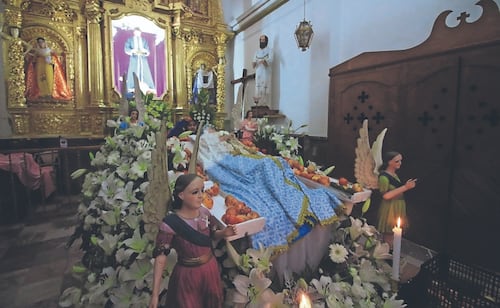
- The Parroquia de Santa María de la Asunción in Amozoc, Puebla, Mexico, houses a revered image of the Virgen del Tránsito, also known as the Dormition of Mary.
- This image symbolizes Mary's peaceful transition to eternal life, a concept distinct from her Assumption into heaven.
- Surrounding the recumbent figure are apples, which symbolize Mary's purity and incorruptibility, analogous to how an unblemished apple resists decay.
In the town of Amozoc de Mota, located east of Puebla, Mexico, the Parroquia de Santa María de la Asunción holds a unique and moving representation of the Virgin Mary known as the Virgen del Tránsito, or the Dormition of Mary.
This image depicts Mary reclining with her eyes closed, appearing to be in a serene sleep, surrounded by apples. Contrary to interpretations of death, this scene symbolizes the Dormition, representing the moment Mary concluded her earthly life before her bodily and spiritual elevation to heaven. Father Felipe Torres, the parish priest, explains that this devotion commemorates Mary's passage to eternal life, "We remember that moment because the Virgin Mary transits from Earth to heaven."
We remember that moment because the Virgin Mary transits from Earth to heaven.
Ancient Christian narratives recount that an angel informed Mary her earthly mission was complete. The apostles were then miraculously gathered to be with her. Tradition describes Mary falling into a peaceful sleep, leading to this depiction also being called the Dormition. For the Catholic Church, this event precedes the Assumption, celebrated on August 15, which commemorates Mary being taken into heaven body and soul. In Amozoc, these traditions are combined into a single, long-standing celebration.
Adding to the image's mystique are the numerous apples encircling the recumbent Virgin. Father Torres elaborates on their symbolic significance, noting that an intact apple, free from damage, retains its natural properties longer than other fruits. This resilience serves as an analogy for Mary's life. "The apple is similar to the Most Holy Virgin... If we do not damage an apple, it is the only fruit that does not rot, while other fruits rot within two or three days... The apple preserves itself for a long time, just as the Most Holy Virgin, having suffered no sin, will always be seen as immaculate," he explains. This aligns with Catholic doctrine that Mary was preserved from original sin and remained immaculate throughout her life.
The apple is similar to the Most Holy Virgin... If we do not damage an apple, it is the only fruit that does not rot, while other fruits rot within two or three days... The apple preserves itself for a long time, just as the Most Holy Virgin, having suffered no sin, will always be seen as immaculate.
DistantNews Editorial
Originally published by El Universal in Spanish. Translated, summarized, and contextualized by our editorial team with added local perspective. Read our editorial standards.
More Stories



From Our Blog

What Press Freedom Means for the News You Read

What Gets Lost (and Found) When News Is Translated

The Critical Role of Diaspora Media in Global News

What Travellers Should Know About Countries with Restricted Press

A Digital Nomad's Guide to Following Local News
