


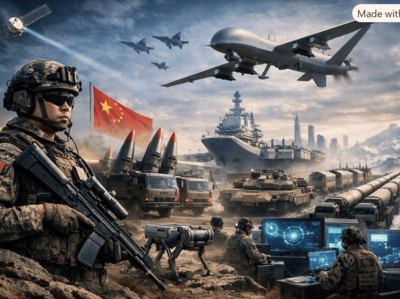
The war China does not announce
Translated from Spanish and summarized by DistantNews. Read the original for the full story.
At a glance
Analysis
Sources not specified
Approved/passed
- China’s revised National Defense Mobilization Law strengthens centralized Communist Party leadership and broadens national mobilization for defense.
- The reform covers emerging capabilities such as artificial intelligence and unmanned systems, and clarifies reserve and defense-service obligations.
- The article frames the changes as preparation for a prolonged, high-intensity confrontation rather than evidence that China plans to start a war immediately.
Beijing has not announced a war, but it is preparing for a harder era. China’s recent reform of the National Defense Mobilization Law does not amount to a declaration of war. It does, however, expand and organize the state’s ability to turn civilian, technological and human resources into defense power at speed.
The reform strengthens the centralized leadership of the Communist Party and gives broader scope to national mobilization. It incorporates emerging sectors such as artificial intelligence and unmanned systems, reflecting a form of warfare built not only on tanks, but also on algorithms, drones and supply chains.
The law also creates a more defined reserve personnel system and clarifies who can be called to perform defense services. Those provisions include obligations for men and women within specified age ranges, subject to stated exceptions.
The article’s focus is not whether China will launch a war tomorrow. It is whether Beijing is building the legal, logistical and human infrastructure needed to withstand, escalate and sustain a major crisis. The reform fits a picture of prolonged competition between blocs, in which preparation may matter almost as much as military deployment.
China still faces a naval disadvantage compared with the United States, particularly in global power projection, operational experience and sustained ocean control. But legal reform, industrial capacity, national mobility and alternative supply routes linked to Russia are presented as ways to reduce that imbalance. Those routes would not remove China’s vulnerabilities, the article argues, but could give it additional room to maneuver in a large-scale conflict.
About this summary
Originally published by Diario Libre in Spanish. Translated, summarized, and contextualized automatically by DistantNews, with a note on how the source frames the story. Not individually reviewed before publishing. How this works.
More Stories


From Our Blog

What Gets Lost (and Found) When News Is Translated

The Critical Role of Diaspora Media in Global News

What Travellers Should Know About Countries with Restricted Press

A Digital Nomad's Guide to Following Local News

How the Same Story Looks Different in Different Countries
