


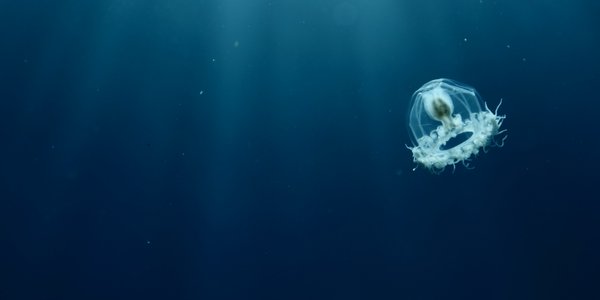
This animal can cheat death. When it starts to die, it simply revives
Translated from Polish, summarized and contextualized by DistantNews.
At a glance
News
Sources not specified
Context piece
- A tiny jellyfish, Turritopsis dohrnii, can reverse its life cycle to avoid death from damage or starvation.
- This biological process, called transdifferentiation, allows the jellyfish to revert to an earlier life stage and start anew.
- While theoretically immortal in labs, the jellyfish can still be killed by predators or disease in the wild.
The tiny Turritopsis dohrnii jellyfish possesses a remarkable ability that sets it apart from most of the animal kingdom: it can cheat death. When faced with damage, starvation, or harsh environmental conditions, this millimeter-sized creature can reverse its development, return to an earlier life stage, and begin its entire life cycle anew. In laboratory settings, this process can theoretically repeat endlessly.
Immortality has long been a subject of human imagination. Today, tech entrepreneurs explore life extension through methods like "young blood" transfusions, cryopreservation, and the concept of a digital afterlife using artificial intelligence. Yet, nature already harbors a small organism that has evolved its own strategy to evade death from aging. This is the Turritopsis dohrnii jellyfish.
Marine biologist Maria Pia Miglietta of Texas A&M University explains that the jellyfish exhibits an extraordinary response to conditions that would be fatal to other organisms. "Turritopsis is unique because it can survive conditions that would be fatal to other organisms – high temperatures, physical damage, starvation, or the presence of chemicals in the water. No matter what we try to harm it with, it doesn't die," she told The Guardian.
The typical jellyfish life cycle begins as a larva called a planula, which develops into a polyp, a small, immobile form. From the polyp, free-swimming jellyfish emerge, mature, and reproduce. Most then gradually cease swimming, their bodies decompose, and they die. However, Turritopsis dohrnii can avert this fate. Instead of perishing, the jellyfish reverts to an earlier developmental stage, initiating its life cycle again. This mechanism, known as cellular transdifferentiation, makes the jellyfish appear to be dying as it shrinks into a small, spherical structure. The process, akin to a butterfly's metamorphosis in reverse, results in a new polyp with the same genetic makeup as the original jellyfish within 24 to 48 hours. This ability means the jellyfish can theoretically live forever, though in the wild, they remain vulnerable to predators and disease.
Turritopsis is unique because it can survive conditions that would be fatal to other organisms – high temperatures, physical damage, starvation, or the presence of chemicals in the water. No matter what we try to harm it with, it doesn't die.
DistantNews Editorial
Originally published by Rzeczpospolita in Polish. Translated, summarized, and contextualized by our editorial team with added local perspective. Read our editorial standards.
More Stories



From Our Blog

What Gets Lost (and Found) When News Is Translated

The Critical Role of Diaspora Media in Global News

What Travellers Should Know About Countries with Restricted Press

A Digital Nomad's Guide to Following Local News

How the Same Story Looks Different in Different Countries
