


“This Time, Citizens Are Watching”: CCTV Satire Appears Outside Jeju Police Station
Translated from Korean and summarized by DistantNews. Read the original for the full story.
At a glance
News
Official statement
Under investigation
- A public-service advertising campaign in Jeju has installed a fake CCTV camera outside a police station following controversy over the handling of a missing-person case.
- The campaign refers to a woman whose body was found 104 days after her disappearance and criticizes gaps in early police response and CCTV preservation.
- Its organizers say the installation targets systemic weaknesses and accountability rather than a specific individual.
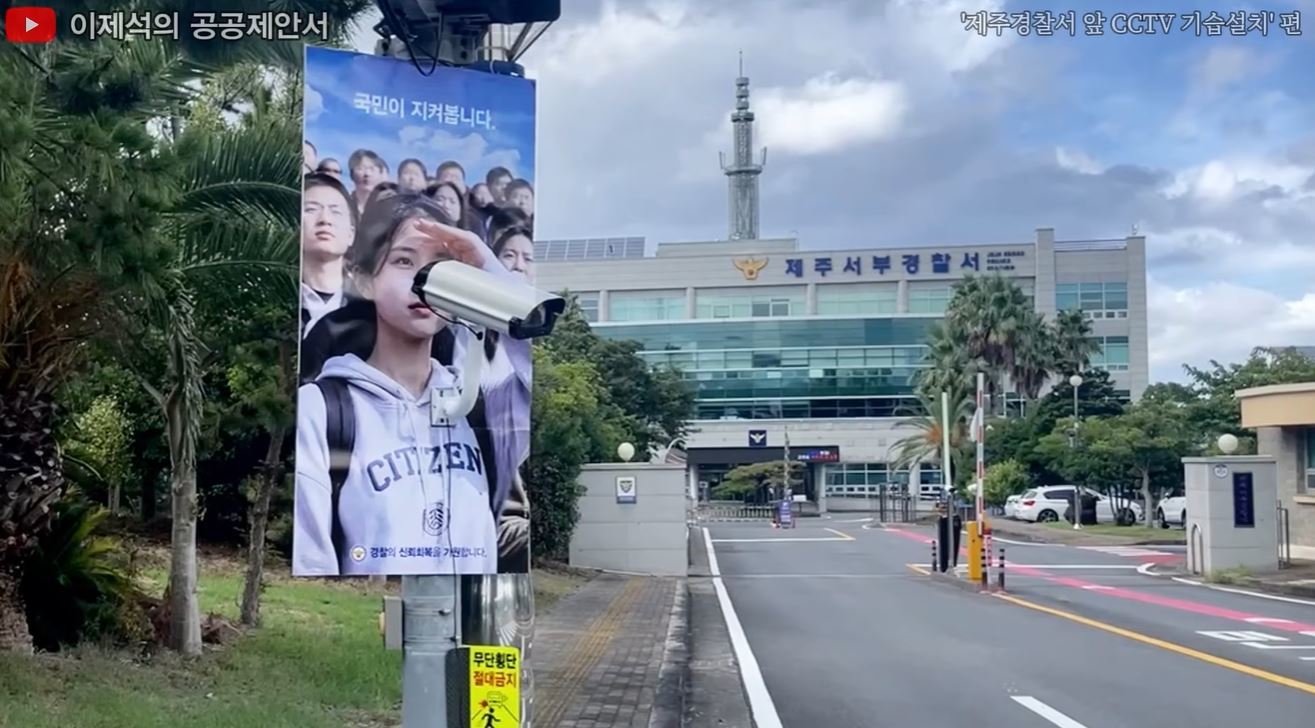
A fake CCTV camera now watches over the area outside Jeju Western Police Station, turning a familiar tool of police surveillance back toward the police themselves.
The public-service campaign, created by the Jesuk Lee Advertising Research Institute, appeared on June 30 in Jeju’s Hallim area and near the station. It follows the discovery of the body of a woman in her 30s, identified by her surname Jang, 104 days after she was reported missing. The station had employed an officer who falsely closed her missing-person report by claiming she had made contact.
The greater the power, the greater the checks. The people are watching.
The installation shows a citizen looking beyond a CCTV camera and carries the message: “The greater the power, the greater the checks. The people are watching.” The model outside the police station does not actually record footage.
This campaign reverses the gaze of CCTV, a representative device through which police watch citizens, and asks about the police’s role and responsibility from the citizens’ perspective.
The institute said the campaign reverses the direction of the CCTV gaze, asking citizens to examine the police’s role and responsibilities. It also referred to reports that CCTV footage potentially available during the early stages of the case disappeared after the retention period expired, before an official request to view it was made.
The organizers said the work was designed to satirize weaknesses in the system and questions of responsibility, rather than attack any particular person.
The work focuses on satirizing weaknesses in the system and questions of responsibility, rather than attacking a specific individual.
About this summary
Originally published by Hankyoreh in Korean. Translated, summarized, and contextualized automatically by DistantNews, with a note on how the source frames the story. Not individually reviewed before publishing. How this works.
More Stories

From Our Blog

What Gets Lost (and Found) When News Is Translated

The Critical Role of Diaspora Media in Global News

What Travellers Should Know About Countries with Restricted Press

A Digital Nomad's Guide to Following Local News

How the Same Story Looks Different in Different Countries
