

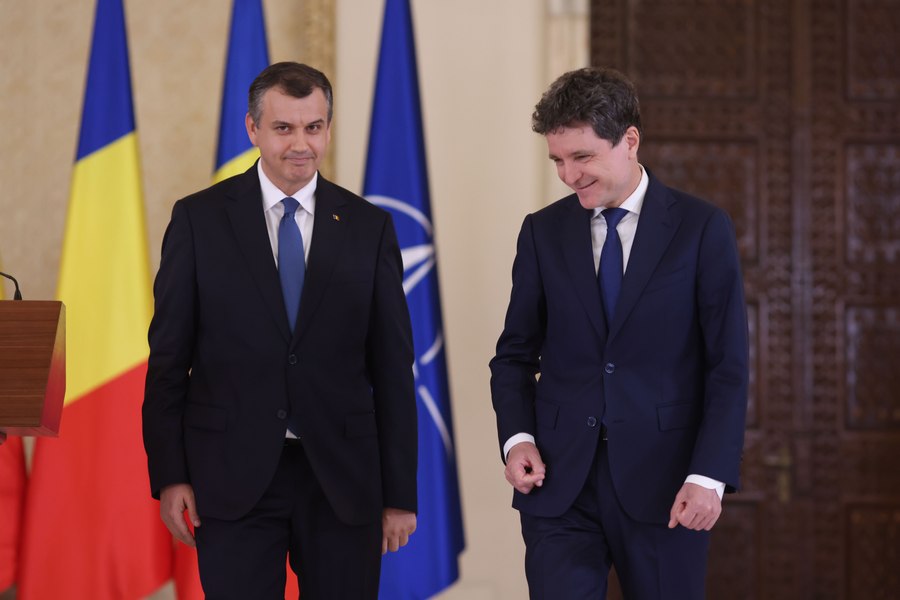

Three scenarios for Nicușor Dan amid political crisis: Analyst says public deserves president's perspective
Translated from Romanian and summarized by DistantNews. Read the original for the full story.
At a glance
Analysis
Named sources
Ongoing story
- Political negotiations for forming a new government in Romania are blocked, leading to unconventional scenarios like a technocratic prime minister or extending an interim executive's mandate.
- An analyst suggests these scenarios reflect a leadership crisis and difficulty in governing amid a complex economic context, with early elections being an invalid option by the president.
- The president's potential involvement in government formation, possibly through figures like Eugen Tomac, is discussed, though the analyst notes such initiatives may not secure a stable majority.
Romania faces a political deadlock as negotiations for a new government stall, opening the door to unconventional solutions. Analysts are discussing scenarios ranging from appointing a technocratic prime minister to extending the mandate of an interim executive.
It's a scenario that remains on the table through the perspective of what this scenario represents. Because this scenario actually represents the failure of the main parties to find a political solution to the crisis triggered in recent months.
Political analyst Costin Ciobanu explained that these discussions highlight a crisis in party leadership and the challenges of assuming governance in a difficult economic climate. With early elections, a common recourse in Western democracies during political crises, ruled out by the president, Romania appears to be opting for a "time-out" in its politics. This often involves the figure of a technocrat, though Ciobanu notes this option has lost some of its appeal.
We, not having this perspective, choose a kind of "time-out" of Romanian politics, associated with this figure of the technocrat, who has lost some of its shine in recent times.
Recent reports suggest the president may be taking a more active role in government formation. The name of Eugen Tomac has surfaced as a potential candidate, though Ciobanu views this as a secondary proposal after initial considerations of technocrats from institutions like the National Bank of Romania or the International Monetary Fund. Tomac, currently a party leader, is not considered a technocrat himself.
Here appeared an attempt by the president to very clearly and clearly assume governance.
Ciobanu commented on the president's apparent attempt to "very clearly and clearly assume governance." However, he noted the lack of public clarity from the president's office regarding the testing of names like Tomac or their potential to form a stable majority. The analyst emphasized that discussions are heavily reliant on "sources," with no definitive public perspective offered by the president.
Mr. Tomac can be anything, but not a technocrat. Even at this moment, he is a party leader, he has political consistency, everyone knows his political path.
About this summary
Originally published by Adevărul in Romanian. Translated, summarized, and contextualized automatically by DistantNews, with a note on how the source frames the story. Not individually reviewed before publishing. How this works.
More Stories
From Our Blog

News in Translation: What Gets Lost, and How We Keep the Framing

Diaspora Media: How Communities Abroad Follow Home

Traveling Where the Press Is Not Free: How to Read the News There

The Digital Nomad's Guide to Local News

The Same Story, Different Countries: How Coverage Changes at the Border
