


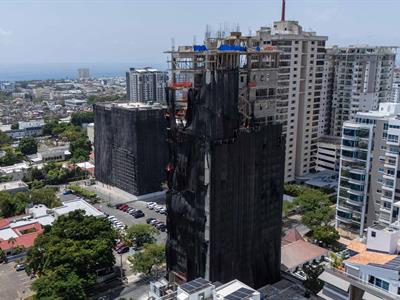
Towers and housing lead permit demand in Dominican Republic
Translated from Spanish, summarized and contextualized by DistantNews.
At a glance
News
Named sources
Context piece
- High-rise buildings and housing projects lead construction permit applications in the Dominican Republic, particularly in the National District, Santiago, and Punta Cana.
- The Ministry of Housing and Buildings (Mived) issued over 1,100 permits in the first seven months of the year, representing over 406 billion pesos in private investment.
- Minister Víctor Bisonó acknowledged construction informality and stressed the need to comply with laws, noting ongoing efforts to strengthen supervision and update seismic design regulations.
High-rise buildings and housing projects are driving demand for construction permits in the Dominican Republic, with the National District, Santiago, and Punta Cana being key areas. The Ministry of Housing and Buildings (Mived) reported issuing 1,122 construction licenses in the first seven months of this year, an 85.45% increase from the same period last year, following a modernization plan for permit processing initiated in January.
we are making it easy and accompanying everyone who wants to build formally and with good practices.
These permits, which validate the viability and safety of construction projects, cover a total private investment of 406.715 billion pesos. Other significant permit requests came from infrastructures for tourism, commercial plazas, industrial warehouses in free zones, and gas stations. In July alone, 201 licenses were granted, totaling 76.524 billion pesos in investment.
Minister of Housing Víctor Bisonó stated that the modernization of permit systems aims to facilitate formal construction under good practices. However, he acknowledged the prevalence of informal construction, lamenting that some large projects begin construction despite notifications. Bisonó cited recent earthquakes in Colombia and Venezuela as a "wake-up call" for builders and developers to adhere to the law.
Here we are living a situation of constructions that are large and important; we have notified them ten times and, as soon as we turn our backs, they start building again.
The ministry is working on a reevaluation under the new Penal Code to strengthen infrastructure supervision. Bisonó also confirmed that consultations are underway with construction guilds to update the R-001 Regulation for Seismic Analysis and Design of Structures, commonly known as the seismic code. Geologist Osiris de León suggests this code needs updating to include seismic microzonation and response evaluation.
represent a 'wake-up call' to builders and developers that the law must be complied with.
DistantNews Editorial
Originally published by Diario Libre in Spanish. Translated, summarized, and contextualized by our editorial team with added local perspective. Read our editorial standards.
More Stories

From Our Blog

What Gets Lost (and Found) When News Is Translated

The Critical Role of Diaspora Media in Global News

What Travellers Should Know About Countries with Restricted Press

A Digital Nomad's Guide to Following Local News

How the Same Story Looks Different in Different Countries
