

Tragedy of Bözödújfalu: New exhibition recalls the history of the village submerged by water
Translated from Hungarian, summarized and contextualized by DistantNews.
At a glance
In-depth
Sources not specified
Context piece
- A new exhibition in Hungary commemorates the history of the village of Bözödújfalu, submerged by a dam in 1988.
- The exhibition uses modern technology to preserve memories of the village and its inhabitants.
- The village's Catholic church tower, which stood as a symbol of the submerged settlement, has been rebuilt with international donations and consecrated in 2024.
An exhibition in Hungary is bringing the story of Bözödújfalu back to life. The village was submerged over 30 years ago when a dam was built in 1988. The exhibition aims to preserve the memories of the former village and its inhabitants, using contemporary technology to bridge the gap between the physical space and digital remembrance. István Kinda, whose childhood summers were spent in the now-submerged settlement, described the former village as a significant part of his family's history. He emphasized the need for 21st-century tools to effectively convey the museum's mission of safeguarding historical memories, as the remaining stone walls alone cannot tell the full story of the community.
Visual artist Balázs Hugyecskek created a light and sound installation for the exhibition. His core idea was to reintroduce the presence of water into the space in a way that is poignant but not overwhelming, serving as a reminder of the village's destruction in 1988. The exhibition also features the sound of bells, played from recordings at noon and midnight, to signify that life once existed in this place.
The former village was not just a research area for me, but a written page from the family chronicle, as I spent several summers of my childhood in the flooded settlement.
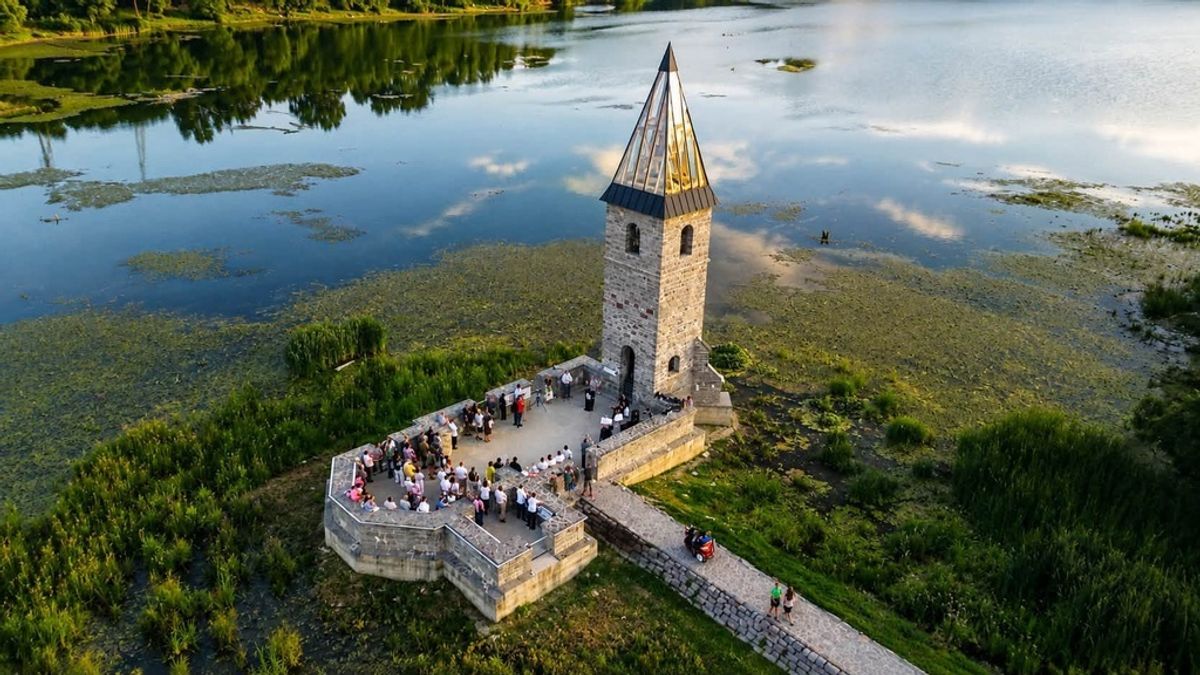
The Roman Catholic church tower, which remained visible above the water for two decades after the village was flooded, became a symbol of its destruction. This tower, which collapsed in 2014, has since been rebuilt through public donations. The reconstruction was initiated by Attila Zoltán Csibi, who was the mayor of Erdőszentgyörgy, a town neighboring the submerged settlement, at the time. He felt a duty to create a lasting memorial for the native village of the Bözödújfalu residents who had found refuge in the small town. The Church of Belonging, built with donations from Hungarians worldwide, was consecrated in 2024. Representing all the former denominations of the village, which once had five churches, the memorial structure imitates the original, partially collapsed, ruined church. Its nave is open, and the tower's spire is made of glass, giving the distant impression of missing roof tiles.
somehow bring the water back into this space as much as it is not yet painful, but still reminds of the 1988 village destruction.
DistantNews Editorial
Originally published by Magyar Nemzet in Hungarian. Translated, summarized, and contextualized by our editorial team with added local perspective. Read our editorial standards.
More Stories

From Our Blog

Countries Without a Free Press: What You Need to Know

What Press Freedom Means for the News You Read

What Gets Lost (and Found) When News Is Translated

The Critical Role of Diaspora Media in Global News

What Travellers Should Know About Countries with Restricted Press
