


Transit trade with Kabul hits historic low
Summarized and contextualized by DistantNews.
At a glance
News
Documents & data
Context piece
- Afghanistan-Pakistan transit trade has plummeted to $367 million in FY26, a sharp decline from previous years, as Kabul increasingly favors Iranian and Central Asian trade routes.
- While Pakistan's border closure in October 2025 accelerated the drop, Afghanistan had already been diversifying its trade routes to reduce reliance on Pakistani ports.
- Reverse transit trade, allowing Afghan exports to reach third countries, has also collapsed dramatically.
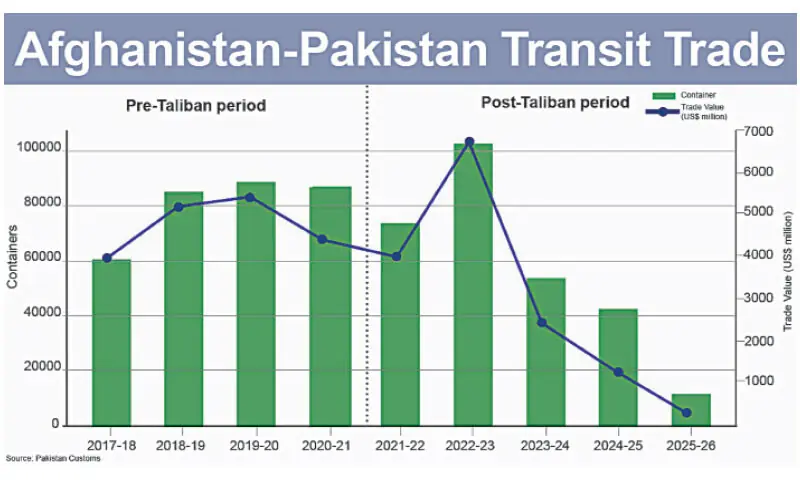
The decades-old Afghanistan-Pakistan transit trade corridor is experiencing a historic collapse, with trade falling to just $367 million in fiscal year 2026, down from nearly $5 billion before the Taliban's return to power. This dramatic decline is attributed to Afghanistan's growing reliance on trade routes through Iran and Central Asia, coupled with Pakistan's border restrictions. While Pakistan's decision to close its border in October 2025 is seen as a significant factor, data indicates that Afghanistan had already begun shifting its trade strategies well before this measure.
Trade analysts suggest that the border closure did not initiate Afghanistan's search for alternative routes but rather marked the culmination of a deliberate policy by the Afghan Taliban to lessen dependence on Pakistani ports. Kabul has actively pursued expanding trade via Iran and strengthening commercial ties with its Central Asian neighbors. For decades, Pakistan served as Afghanistan's most accessible and primary gateway to global markets. Container traffic through Pakistan had shown steady growth during the previous democratic government, increasing from approximately 60,500 containers in FY17 to nearly 89,000 in FY21.
Following the Taliban's takeover, transit cargo via Pakistan saw an initial recovery, peaking at 102,886 containers valued at $6.7 billion in FY23. However, this proved to be a temporary resurgence. Transit volumes subsequently dropped to 54,114 containers in FY24 and further to 42,959 containers worth $1.36 billion in FY25, preceding Pakistan's border closure. This trend indicates that the Taliban had already started rerouting a portion of Afghanistan's trade before Islamabad imposed its security-related border restrictions.
The collapse in reverse transit, which facilitates Afghan exports to third countries like India via Wagah, has been even more severe. This aspect of the trade corridor has virtually ceased to function, underscoring the profound shift in Afghanistan's international trade dynamics away from Pakistan.
DistantNews Editorial
Originally published by Dawn. Summarized and contextualized by our editorial team with added local perspective. Read our editorial standards.
More Stories

From Our Blog

What Gets Lost (and Found) When News Is Translated

The Critical Role of Diaspora Media in Global News

What Travellers Should Know About Countries with Restricted Press

A Digital Nomad's Guide to Following Local News

How the Same Story Looks Different in Different Countries
