


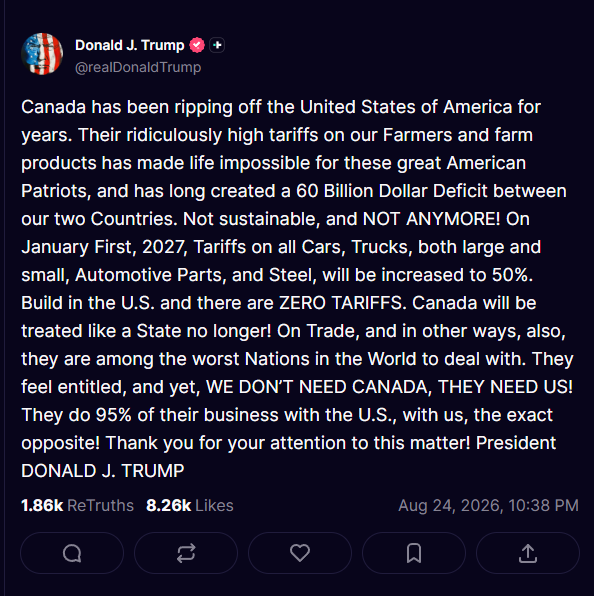
Trump Plans 50% Tariffs on Canadian Cars, Steel from 2027
Translated from Korean, summarized and contextualized by DistantNews.
At a glance
News
Named sources
New plan
- Former U.S. President Donald Trump announced plans to increase tariffs on Canadian cars, trucks, and steel to 50% starting January 2027.
- Trump stated that Canada has been "extorting" the U.S. and will no longer be treated like an American state, citing a $60 billion trade deficit.
- Canada's Prime Minister Mark Carney responded by vowing retaliatory tariffs on U.S. goods, escalating the trade dispute.
Former U.S. President Donald Trump has declared his intention to impose a 50% tariff on all Canadian cars, trucks, automotive parts, and steel, effective January 1, 2027. Trump asserted that Canada has engaged in "extortion" against the United States for years and will no longer receive preferential treatment, likening the current relationship to one where Canada is not treated as a U.S. state. He pointed to a long-standing trade deficit of $60 billion between the two nations, deeming it unsustainable. Trump also noted that tariffs would be waived for vehicles manufactured within the U.S. This announcement follows a recent escalation in trade tensions, where Trump had initially threatened tariffs of up to 50% on various Canadian goods, including wine, furniture, and dairy products, before implementing a three-day grace period. Despite subsequent negotiations in Washington D.C., the talks failed, leading the U.S. to begin imposing the 50% tariffs on approximately $20 billion worth of Canadian goods on August 22. The proposed tariffs on vehicles and steel would add significantly to this trade friction. In response, Canadian Prime Minister Mark Carney vowed that Canada would retaliate with equivalent tariffs on U.S. products, scheduled to take effect on September 8. These retaliatory measures are expected to target steel, dairy, home appliances, agricultural machinery, pulp and paper, and electronics. Trump continued to criticize Canada, stating on August 23 that the country desires benefits without acting as a U.S. state.
DistantNews Editorial
Originally published by Dong-A Ilbo in Korean. Translated, summarized, and contextualized by our editorial team with added local perspective. Read our editorial standards.
More Stories


From Our Blog

What Gets Lost (and Found) When News Is Translated

The Critical Role of Diaspora Media in Global News

What Travellers Should Know About Countries with Restricted Press

A Digital Nomad's Guide to Following Local News

How the Same Story Looks Different in Different Countries
