


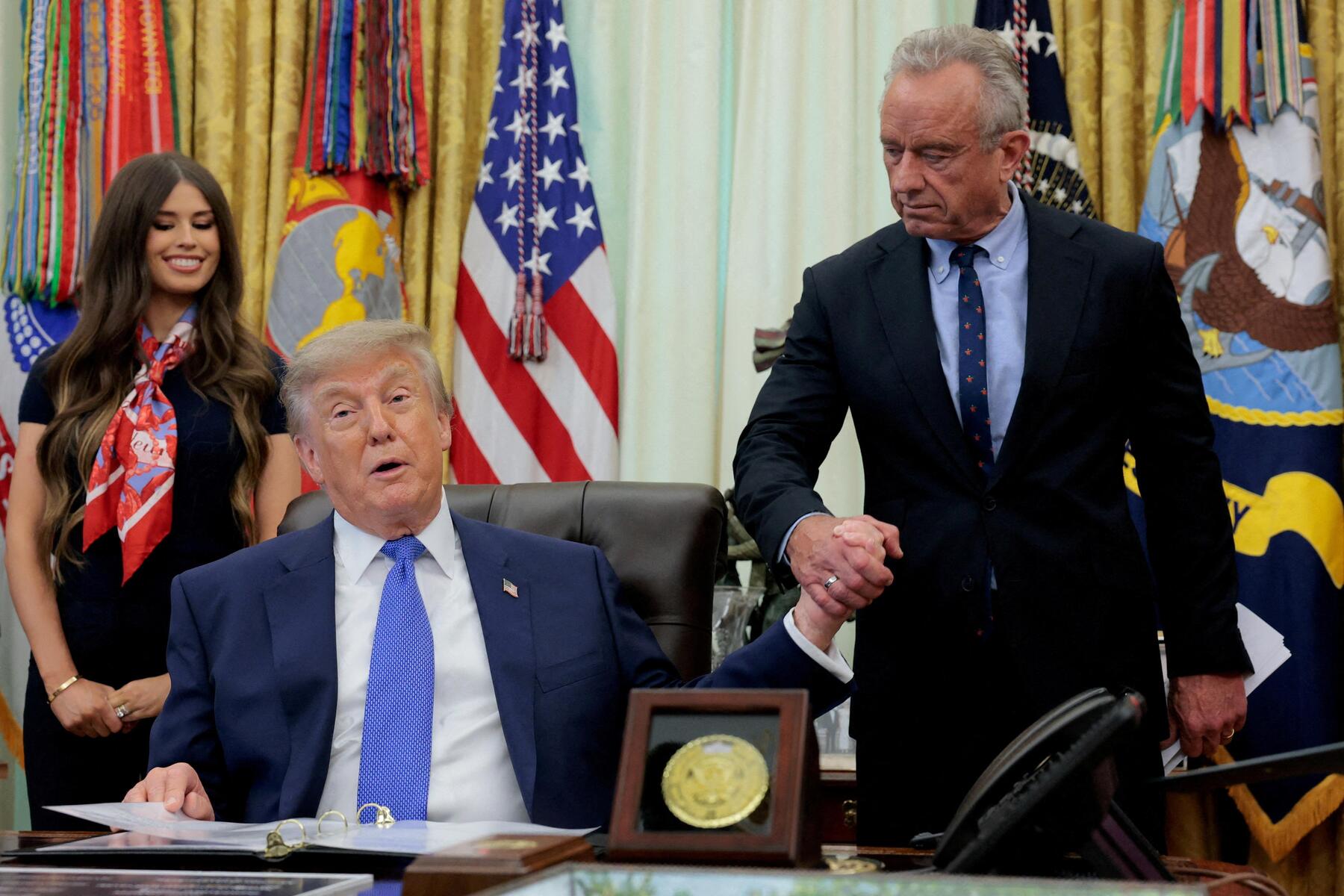
Trump Questions Combination Vaccines, Advocates for Fewer Childhood Shots
Translated from German, summarized and contextualized by DistantNews.
At a glance
News
Sources not specified
New plan
- U.S. President Donald Trump announced plans to recommend fewer childhood vaccinations, suggesting combination vaccines could be "pretty deadly."
- Trump intends to remove some vaccines from the standard child immunization schedule and spread others over multiple doctor visits.
- Health experts and the CDC state there is no scientific evidence linking vaccines to autism or that separating the MMR vaccine offers benefits.
President Donald Trump has signaled a significant shift in U.S. vaccination policy, advocating for fewer recommended childhood immunizations and expressing concerns about combination vaccines. During an event at the White House, Trump declared that his administration would only recognize vaccinations against eleven diseases as central recommendations for all children. This move could potentially alter the standard immunization schedule, with some vaccines being removed entirely and others recommended to be administered individually over multiple appointments.
Combination vaccines could be 'pretty deadly'.
Trump controversially stated that combination vaccines could be "pretty deadly," a claim he admitted was based on anecdotal accounts rather than scientific evidence. When pressed by a journalist for proof, he responded, "No," but added that he had heard such assertions from people. He also linked the proposed changes to the ongoing debate surrounding autism, suggesting that fewer and more spaced-out vaccinations might reduce autism diagnoses. However, the U.S. Centers for Disease Control and Prevention (CDC) has stated that there is no scientific basis for the claim that separating the measles, mumps, and rubella (MMR) vaccine provides any benefit. Furthermore, extensive scientific research has not established a causal link between vaccinations and autism.
No.
The practical implications of Trump's announcement remain unclear, as many vaccination rules are determined at the state level, and a similar proposal was previously blocked by a federal court. Currently, single-dose vaccines for measles, mumps, and rubella are not available in the United States. Health experts have warned that requiring additional doctor visits could lead to children remaining unprotected for longer periods or missing subsequent vaccinations altogether. Despite these concerns, Trump emphasized that parents would still have the option to choose all vaccinations for their children, and these would continue to be covered by insurance.
For a special benefit of dividing the MMR vaccine, according to the US health authority CDC, there is no scientific evidence.
DistantNews Editorial
Originally published by Die Presse in German. Translated, summarized, and contextualized by our editorial team with added local perspective. Read our editorial standards.
More Stories



From Our Blog

What Gets Lost (and Found) When News Is Translated

The Critical Role of Diaspora Media in Global News

What Travellers Should Know About Countries with Restricted Press

A Digital Nomad's Guide to Following Local News

How the Same Story Looks Different in Different Countries
