


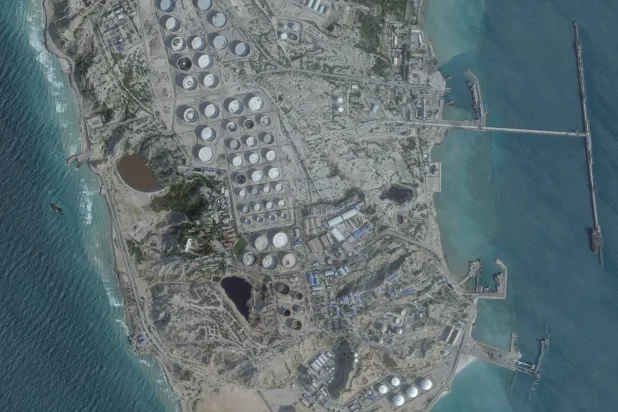
Trump Says Iran’s Kharg Is Being ‘Blown to Smithereens’ but Offers No Details
Translated from English and summarized by DistantNews. Read the original for the full story.
At a glance
News
Named sources
Ongoing story
- Iran vowed a “decisive response” after the United States attacked rocket launchers on a small island near the Strait of Hormuz.
- Iran’s Revolutionary Guards said they struck two US bases in Jordan with ballistic missiles and shot down a US drone, while Jordan said it intercepted eight missiles.
- The exchange followed months of reduced hostilities despite stalled ceasefire and peace efforts, with Washington applying economic pressure on Tehran.
A fresh exchange of fire between the United States and Iran has unsettled a conflict that had entered a period of reduced hostilities. Iran’s Revolutionary Guards said they retaliated against two US military bases in Jordan after Washington attacked Iranian rocket launchers on an island in the Strait of Hormuz.
The Guards claimed their ballistic-missile strikes caused “heavy damage” and said they had shot down a US drone over the strait. Jordan’s army said it intercepted eight missiles but did not identify their origin. The United States said its own operation targeted Iranian forces preparing to lay more sea mines in the strategic shipping lane.
We are not seeking war, but we will deliver a decisive response to the aggressors.
“US forces took limited, precise action against IRGC (Iran’s Revolutionary Guards’) minelaying forces posing an imminent threat in the Strait of Hormuz,” US Central Command wrote on X. Navy Captain Tim Hawkins said American forces had completed clearing sea mines from international shipping routes the previous week and remained ready to protect commercial traffic.
US forces took limited, precise action against IRGC (Iran’s Revolutionary Guards’) minelaying forces posing an imminent threat in the Strait of Hormuz.
Iranian officials described the US strikes as causing casualties and called the attack on Jordan a response to “US-Zionist aerial aggression.” President Masoud Pezeshkian said Iran was not seeking war but would respond decisively. His statement came before a trip to Kyrgyzstan for a summit attended by Russia’s Vladimir Putin and China’s Xi Jinping.
The confrontation came shortly after the war reached its six-month mark. A ceasefire agreed in April ended the most intense fighting, and the sides signed a memorandum of understanding in June, but no final peace agreement followed. Washington has since emphasized “economic warfare,” including a naval counterblockade that has tightened pressure on Iran’s fuel supplies. Tehran has also effectively blocked the strait, through which one-fifth of the world’s oil passed before the conflict began.
US forces are monitoring the area closely and remain prepared to protect the free flow of commerce through this essential waterway.
About this summary
Originally published by Asharq Al-Awsat in English. Translated, summarized, and contextualized automatically by DistantNews, with a note on how the source frames the story. Not individually reviewed before publishing. How this works.
More Stories


From Our Blog

What Gets Lost (and Found) When News Is Translated

The Critical Role of Diaspora Media in Global News

What Travellers Should Know About Countries with Restricted Press

A Digital Nomad's Guide to Following Local News

How the Same Story Looks Different in Different Countries
