

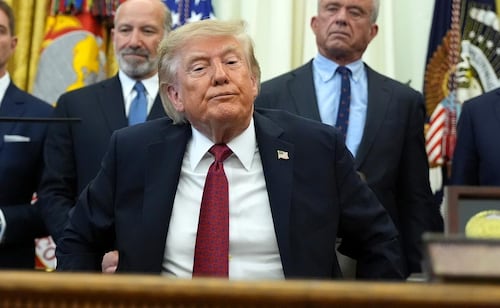
 Image: Jacquelyn Martin
Trump Suggests He Could Withdraw U.S. Support for British Sovereignty Over the Falklands
Translated from Spanish and summarized by DistantNews. Read the original for the full story.
At a glance
News
Named sources
Ongoing story
- Donald Trump suggested the United States could reconsider its position on British sovereignty over the Falkland Islands.
- The comments followed reports that Washington was considering the move as leverage to push Britain and other NATO members to increase defense spending.
- The United States officially maintains neutrality on the islands while recognizing Britain’s de facto administration.
Donald Trump suggested that the United States could reconsider its position on British sovereignty over the Falkland Islands, a territory claimed by Argentina.
Asked by reporters in the Oval Office whether he was reviewing the U.S. position, Trump replied, “I always review every position. That’s just one of many.” His comments followed British media reports that his administration was considering withdrawing support for Britain’s position to pressure London to spend more on defense.
The Telegraph reported that the proposal appeared on a Pentagon list of possible incentives for securing a NATO commitment to spend 5% on defense. Washington’s official position on the islands is neutrality. It does not explicitly support British sovereignty, although it recognizes Britain’s de facto administration of the archipelago.
Argentina and the United Kingdom fought a war over the islands from April 2 to June 14, 1982. The conflict ended with Argentina’s surrender and the deaths of 649 Argentines, 255 Britons and three islanders. Britain has since rejected Argentina’s claims despite repeated United Nations calls for dialogue. The United Nations considers the Falklands one of the territories pending decolonization.
About 3,000 people live on the islands. In a March 2013 referendum, more than 99% supported remaining a British territory.
I always review every position. That’s just one of many.
About this summary
Originally published by El Universal in Spanish. Translated, summarized, and contextualized automatically by DistantNews, with a note on how the source frames the story. Not individually reviewed before publishing. How this works.
More Stories


From Our Blog

What Press Freedom Means for the News You Read

What Gets Lost (and Found) When News Is Translated

The Critical Role of Diaspora Media in Global News

What Travellers Should Know About Countries with Restricted Press

A Digital Nomad's Guide to Following Local News
