


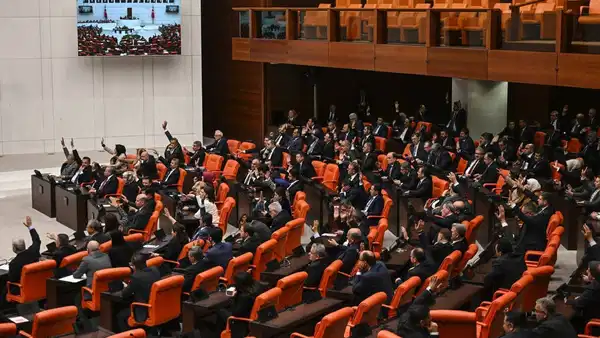
Turkish parliament rejects motion to investigate Sivas Massacre
Translated from Turkish, summarized and contextualized by DistantNews.
At a glance
News
Named sources
Outcome reported
- A Turkish parliamentary motion to investigate the 1993 Sivas Massacre was rejected by the ruling AKP and MHP parties.
- Opposition parties, including CHP and IYI Party, argued for a thorough investigation into the event's causes and failures.
- Speakers highlighted the massacre as a result of hate speech and sectarian division, urging that perpetrators be identified.
A parliamentary motion proposed by Turkey's main opposition party, CHP, to investigate the 1993 Sivas Massacre was rejected in the Grand National Assembly. The ruling AKP and its nationalist ally MHP voted against the motion, which sought to examine all aspects of the event, including legal and administrative processes, and to prevent future occurrences.
This tragic event is the result of a language of hatred and anger; it is the result of the sanctification of violence. It is an indicator of what can happen with mass psychology when hatred, spite, and anger dominate politics and society, and the masses; it is a reflection of how our beautiful country becomes open to provocations when ethnic and sectarian divisions are deepened.
During the debate, IYI Party Group Chair Buğra Kavuncu emphasized the importance of remembering and discussing the Sivas Massacre. He stated, "This tragic event is the result of a language of hatred and anger; it is the result of the sanctification of violence." Kavuncu argued that a full examination is necessary to understand the vulnerabilities, negligence, and provocations that led to the massacre, warning against the dangers of ethnic and sectarian divisions.
However, when we start talking about this motion, I think the first thing we need to contemplate is the acceptance that a tragic event like the Madımak massacre has not yet been illuminated, even after thirty-three years.
Mehmet Emin Ekmen, Deputy Chairman of the Yeniden Refah Party, supported the CHP's motion, highlighting the tragedy that the Sivas Massacre remains unilluminated 33 years later. He criticized the selective application of justice, noting that while judicial practices in Turkey are often criticized, positive developments for those tried in the Sivas case are sometimes scrutinized. Ekmen suggested that if past massacres like Sivas and Çorum had been adequately addressed, the current need to investigate Sivas might have been avoided.
If we had been able to shed light on Sivas and Çorum at the time, perhaps today we would not be talking about shedding light on Madımak. It is also not possible to see Madımak solely as the Madımak massacre.
AKP Deputy Oğuzhan Kaya called for evaluating the Sivas and Başbağlar massacres together, stating that the perpetrator of Başbağlar is also the perpetrator of Sivas. He noted that 111 people were prosecuted in the Sivas case, with 107 defendants. The rejection of the investigation motion means that the full truth behind the Sivas Massacre, which resulted in the deaths of 33 intellectuals and artists, may remain obscured.
Whoever is the perpetrator of Başbağlar, that is also the perpetrator of Sivas.
DistantNews Editorial
Originally published by Cumhuriyet in Turkish. Translated, summarized, and contextualized by our editorial team with added local perspective. Read our editorial standards.
More Stories
From Our Blog

What Gets Lost (and Found) When News Is Translated

The Critical Role of Diaspora Media in Global News

What Travellers Should Know About Countries with Restricted Press

A Digital Nomad's Guide to Following Local News

How the Same Story Looks Different in Different Countries
