

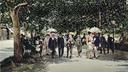
Two bullets fired in Sarajevo pushed the world into catastrophe, and saved a gymnasium student, Princip, from the death penalty for 27 days
Translated from Croatian, summarized and contextualized by DistantNews.
At a glance
In-depth
Sources not specified
Context piece
- The article recounts the events leading up to the assassination of Archduke Franz Ferdinand in Sarajevo on June 28, 1914.
- It details the failed bomb attempt by Nedeljko Čabrinović and the successful shooting by Gavrilo Princip, highlighting the weak security measures in place.
- The assassination is presented as the catalyst for World War I, emphasizing the tense political climate following Austria-Hungary's annexation of Bosnia and Herzegovina.
The assassination of Archduke Franz Ferdinand and his wife Sophie in Sarajevo on June 28, 1914, was a pivotal moment that plunged the world into a devastating conflict. The initial assassination attempt by Nedeljko Čabrinović involved throwing a bomb, followed by an attempt to ingest cyanide and jump into the Miljacka River. However, the poison was expired, and the river was too shallow, thwarting his efforts.
Ultimately, it was nineteen-year-old Gavrilo Princip who succeeded in assassinating the heir to the Austro-Hungarian throne. This act ignited an unstoppable chain of events that propelled Europe and the rest of the world into a global conflict of unprecedented scale. The assassination occurred against a backdrop of extreme tension, particularly after Austria-Hungary's official annexation of Bosnia and Herzegovina in 1908. The Archduke's visit to Sarajevo on Vidovdan, a date deeply symbolic and provocative in Serbian national mythology due to its connection to the 1389 Battle of Kosovo, further inflamed the situation.
Despite warnings of a potential assassination, security measures were notably inadequate. A proposal by local military commander General Michael von Appel to line the entire route with soldiers was rejected, with the explanation that such a display would offend loyal Sarajevo citizens. Consequently, the security for the six-kilometer procession was entrusted to only about sixty local police officers. One officer's alleged remark that security on June 28 would be left to "God's providence" proved eerily prophetic.
Six young members of the revolutionary organization "Young Bosnia" were positioned along the Appel Quay by the Miljacka River, armed with bombs and pistols, intending to send a strong political message to imperial Vienna about the unsustainability of their rule in the region. The first opportunity arose around 10:10 AM, but Muhamed Mehmedbašić, the first assassin in line, inexplicably failed to act as the motorcade passed the Mostarska café. Shortly thereafter, near the Ćumurija Bridge, Nedeljko Čabrinović stepped forward and threw a bomb toward the third vehicle, an open Gräf & Stift car carrying Franz Ferdinand and Sophie. The driver, Alois Seyfried, instinctively accelerated, causing the bomb to bounce off the car's convertible roof, roll onto the street, and explode beneath the subsequent vehicle in the convoy.
DistantNews Editorial
Originally published by Večernji List in Croatian. Translated, summarized, and contextualized by our editorial team with added local perspective. Read our editorial standards.
More Stories



From Our Blog

What Gets Lost (and Found) When News Is Translated

The Critical Role of Diaspora Media in Global News

What Travellers Should Know About Countries with Restricted Press

A Digital Nomad's Guide to Following Local News

How the Same Story Looks Different in Different Countries
