


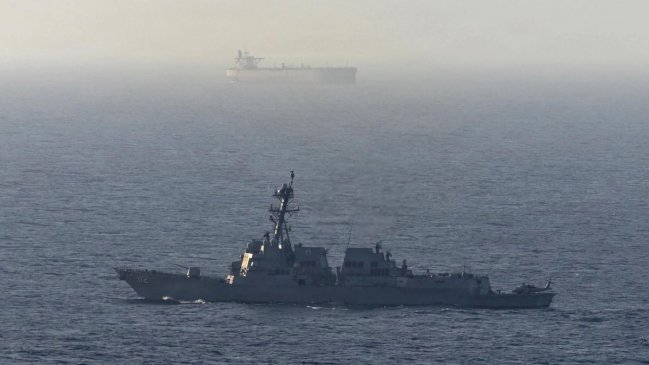
U.S. and Iran clash over Strait of Hormuz control amid escalating attacks
Translated from Spanish, summarized and contextualized by DistantNews.
At a glance
News
Named sources
Ongoing story
- The U.S. and Iran have escalated tensions over the Strait of Hormuz, with President Trump declaring the U.S. will be its "guardian."
- Iran's military warned against U.S. interference in the crucial waterway, following recent cross-border attacks.
- The U.S. conducted new drone strikes targeting Iranian naval facilities, while Iran retaliated with missile and drone attacks on bases in Jordan and Kuwait.
The United States and Iran have intensified their dispute over control of the Strait of Hormuz, with President Donald Trump announcing the U.S. will act as the "guardian" of the vital passage and intends to charge a commission for merchant vessel protection. This declaration follows three consecutive nights of escalating attacks between the two nations.
We are going to hit them very hard and we are going to keep the strait safe, and we are probably going to run it. We will become the guardian of the strait... And we should be compensated for that.
Trump stated in a phone interview that the U.S. would "guard" the strait and manage it, implying a fee for securing ships transiting the area. "We are going to hit them very hard and we are going to keep the strait safe, and we are probably going to run it. We will become the guardian of the strait... And we should be compensated for that," he said.
We are going to hit them very hard and we are going to keep the strait safe, and we are probably going to run it. We will become the guardian of the strait... And we should be compensated for that.
In response, Iran's Unified Command spokesperson, Ebrahim Zolfaghari, issued a stern warning, asserting that the Iranian military would not permit U.S. "interference in the management of the Strait of Hormuz under any circumstances." Meanwhile, Iran announced that recent talks with Oman aimed at establishing a mechanism for ensuring safe navigation through the strait were unsuccessful, citing "open pressure from the U.S. on Oman."
under any circumstances
The exchange of threats occurred after U.S. forces launched a new offensive Sunday night, utilizing maritime drones for the first time in combat to strike an Iranian submarine and surface vessel maintenance center. The Pentagon stated the goal was to further degrade Iran's capacity to attack merchant ships. Iran retaliated with missile and drone attacks targeting U.S. military bases and facilities in neighboring countries. Jordanian military sources reported their air defenses intercepted four missiles originating from Iranian territory, while Kuwaiti forces engaged hostile aerial targets in their airspace.
We tried, in consultation with Oman, to reach a mechanism that guaranteed the safe passage of ships through the Strait of Hormuz, but, unfortunately, due to the open pressure of the U.S. on Oman, it was not achieved.
DistantNews Editorial
Originally published by Cooperativa in Spanish. Translated, summarized, and contextualized by our editorial team with added local perspective. Read our editorial standards.
More Stories

From Our Blog

What Gets Lost (and Found) When News Is Translated

The Critical Role of Diaspora Media in Global News

What Travellers Should Know About Countries with Restricted Press

A Digital Nomad's Guide to Following Local News

How the Same Story Looks Different in Different Countries
