


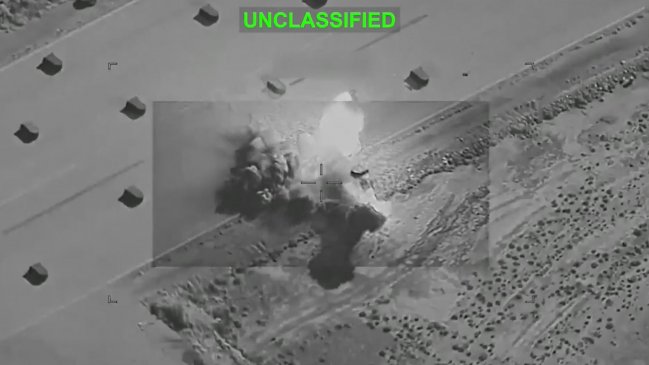
US launches new attacks on Iran after Strait of Hormuz incident
Translated from Spanish, summarized and contextualized by DistantNews.
At a glance
News
Official statement
Ongoing story
- The U.S. launched a new round of attacks against Iran after Iran allegedly attacked a Cypriot-flagged vessel in the Strait of Hormuz.
- U.S. Central Command stated Iran's attack caused a fire and damage, with one crew member missing.
- This escalation follows Iran's announcement that the Strait of Hormuz would remain closed indefinitely.
The United States initiated a new series of strikes against Iran on Saturday, following an alleged Iranian attack on a commercial ship in the Strait of Hormuz. The U.S. Central Command (Centcom) reported that the Iranian action targeted a container ship flying a Cypriot flag, resulting in a fire and damage to the engine room.
To Iran, we were given a new opportunity to demonstrate compliance with the memorandum of understanding after being held accountable for previous attacks against commercial vessels, but again it has failed.
According to Centcom, the attack forced the vessel to halt its journey, and one crew member is currently reported missing. The military command stated that Iran had been given an opportunity to demonstrate compliance with a memorandum of understanding after previous attacks on commercial vessels but "has failed again." The U.S. forces justified their retaliatory strikes as an effort to "degrade Iran's capability" to attack other ships in the crucial waterway.
This development occurred shortly after Iran announced that the Strait of Hormuz would be closed "until further notice." The Islamic Revolutionary Guard Corps issued a warning, stating that any foreign interference aimed at opening an "illegal route" in the region would be met with a forceful response. Iran's Foreign Minister, Abbas Araghchi, had previously accused the U.S. of violating a memorandum of understanding by imposing new sanctions on individuals close to the supreme leader.
Any foreign interference to open an 'illegal route' in the region will receive a strong response.
Araghchi asserted that the U.S. "non-compliance" with the agreement, along with other "violations and mistakes," contributed to the heightened tensions. The U.S. order for these strikes came from President Donald Trump, who recently ended a ceasefire, signaling a significant escalation in the ongoing maritime security concerns in the region.
The non-compliance of the United States with the agreement adds to other violations and mistakes by the North American giant.
DistantNews Editorial
Originally published by Cooperativa in Spanish. Translated, summarized, and contextualized by our editorial team with added local perspective. Read our editorial standards.
More Stories
From Our Blog

What Gets Lost (and Found) When News Is Translated

The Critical Role of Diaspora Media in Global News

What Travellers Should Know About Countries with Restricted Press

A Digital Nomad's Guide to Following Local News

How the Same Story Looks Different in Different Countries
