


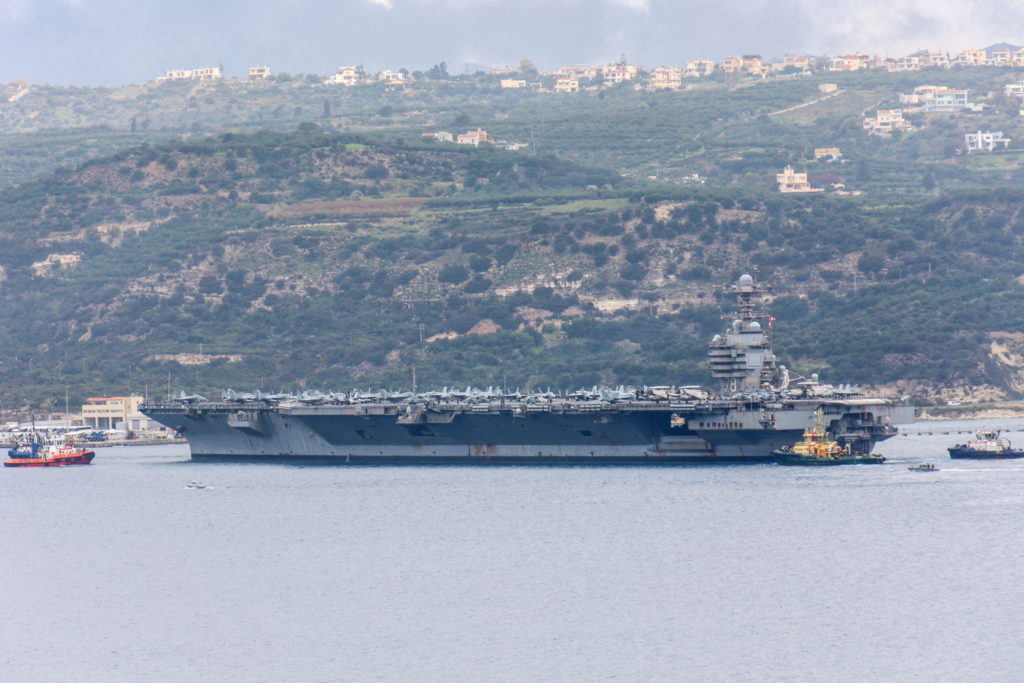
U.S. pulls last aircraft carrier in Asia as Trump focuses on Iran and the Western Hemisphere
Summarized and contextualized by DistantNews.
At a glance
News
Named sources
Ongoing story
- The U.S. has withdrawn its last aircraft carrier from the Asia-Pacific region, leaving the area without a key warship.
- This move aligns with President Trump's focus on Iran and the Western Hemisphere, stretching naval resources.
- Analysts suggest China may exploit the U.S. absence to assert regional dominance and influence allies.
The United States has removed its final aircraft carrier from the Asia-Pacific, a significant shift amid rising Chinese assertiveness in the region. The departure of the USS George Washington to the Middle East, to potentially relieve the USS Abraham Lincoln, underscores President Donald Trump's strategic pivot towards Iran and the Western Hemisphere.
The administration says that the Pacific is supposed to be the most important behind the Western Hemisphere.
This redeployment strains U.S. naval resources, as the USS Abraham Lincoln's deployment has been extended to support operations against Iran. The absence of a U.S. carrier in the Pacific, though potentially short-lived, highlights the impact of sustained operations on sailors and the administration's apparent retreat from its stated Asia-Pacific priorities. Analysts note this creates unpredictability for U.S. allies in the region.
Instead, the U.S. is "doing the exact opposite" of its previously expressed goal of pulling out of the Middle East.
Greg Poling, director of the Southeast Asia Program at the Center for Strategic and International Studies, stated that the administration's actions contradict its declared focus on the Pacific. He observed that Beijing is likely pleased with the U.S. distraction and the resulting unease among its allies. China views the U.S. military presence as a hindrance to its regional ambitions, including its claims over Taiwan.
American allies in the Pacific are unsettled over the unpredictability of the Republican administration, Poling said, while Beijing "is quite happy with U.S. distraction, with the frustration of U.S. allies and partners."
Bryan Clark, a defense analyst at the Hudson Institute, suggested that while China is unlikely to invade Taiwan due to the carrier's absence, Beijing could leverage this situation. China may use the carrier's departure to signal to regional powers like the Philippines, Japan, and Indonesia that the U.S. is no longer the dominant military force in the western Pacific. This could encourage these nations to align more closely with China, perceiving it as the ascendant power capable of guaranteeing their security.
They're using this as part of the narrative to demonstrate to the Philippines, to Japan, to Indonesia and others that the U.S. is not the big dog in the western Pacific anymore.
DistantNews Editorial
Originally published by PBS NewsHour. Summarized and contextualized by our editorial team with added local perspective. Read our editorial standards.
More Stories

From Our Blog

How the Same Story Looks Different in Different Countries

What Gets Lost (and Found) When News Is Translated

The Critical Role of Diaspora Media in Global News

What Travellers Should Know About Countries with Restricted Press

A Digital Nomad's Guide to Following Local News
