


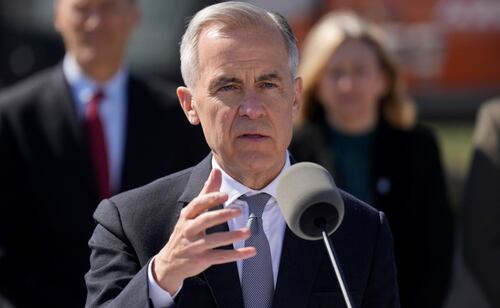
U.S. tariffs violate T-MEC, Carney accuses; says Canada ready to restart negotiations but can also wait
Translated from Spanish, summarized and contextualized by DistantNews.
TLDR
- Canadian Prime Minister Mark Carney stated that U.S. tariffs on Canadian steel, aluminum, forest products, and automobiles violate existing trade agreements.
- Carney indicated Canada is prepared to resume negotiations but can also afford to wait if necessary.
- He attributed the stalled talks, frozen since October 2025, to the changed political climate following the U.S. president's return to the White House.
Canada's top diplomat, Prime Minister Mark Carney, has sharply criticized the United States' imposition of tariffs on key Canadian exports, asserting that these measures directly contravene the spirit and letter of the agreements between the two North American nations. Carney's remarks, delivered during a press conference, highlight a significant point of contention in the ongoing trade relationship, particularly concerning steel, aluminum, forest products, and automobiles. This stance underscores Canada's commitment to defending its economic interests and upholding the integrity of established trade pacts.
There are a series of tariff measures that the United States has imposed that violate the current agreement: tariffs on steel, aluminum, automobiles, and forest products. These measures are not consistent with the current agreement.
While expressing Canada's readiness to re-engage in substantive negotiations with Washington, Carney also conveyed a strategic patience, suggesting that Ottawa is not under undue pressure to concede. The trade talks, which have been in limbo since October 2025 at the behest of the U.S. president, are seen by Canada as being fundamentally altered by the current political climate. Carney's statement implies that the U.S. administration's approach has shifted the dynamics of the negotiation landscape, prompting Canada to focus on strengthening its own economic resilience and independence.
We hope to be able to sit down and negotiate. We have had exchanges on these issues, both to understand what they, I'll use your term, usually call 'trade irritants'.
The Canadian government's recent formation of an Economic Relations with the U.S. Advisory Committee, comprising leaders from various sectors, signals a proactive strategy to navigate this complex economic relationship. This move reflects a broader Canadian approach: to foster domestic strength while engaging internationally. From a Canadian perspective, as reported by El Universal, the U.S. tariffs are not merely economic irritants but represent a challenge to the established framework of North American trade. The emphasis on Canadian self-reliance and prosperity, irrespective of the immediate progress in negotiations, is a narrative that resonates strongly within the country, differentiating it from a purely transactional view of trade often seen in international discourse.
The situation has fundamentally changed. We understand that. That is why we are focused on making Canada stronger, more independent, and more prosperous.
DistantNews Editorial
Originally published by El Universal in Spanish. Translated, summarized, and contextualized by our editorial team with added local perspective. Read our editorial standards.
More Stories



From Our Blog

What Press Freedom Means for the News You Read

What Gets Lost (and Found) When News Is Translated

The Critical Role of Diaspora Media in Global News

What Travellers Should Know About Countries with Restricted Press

A Digital Nomad's Guide to Following Local News
