


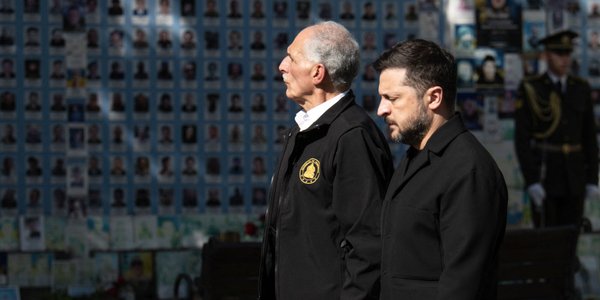
Ukraine's National Pantheon Will Include Figures Evoking Negative Emotions in Poles, Author Warns
Translated from Polish, summarized and contextualized by DistantNews.
At a glance
Analysis
Named sources
New plan
- Ukraine will establish a National Pantheon following President Zelenskyy's approved legislation.
- The pantheon will include figures whose names evoke negative emotions in Poles, a reality that must be accepted.
- National pantheons often divide nations, as historical figures are viewed differently by various groups, exemplified by Napoleon Bonaparte and Jan Leon Kozietulski.
Ukraine's decision to establish a National Pantheon, following President Zelenskyy's approved legislation on July 1, is set to include figures who may evoke negative sentiments among Poles. The author argues that this is a reality that must be accepted, as national pantheons historically tend to divide rather than unite.
And whatever we think about it, people whose names will evoke negative emotions in Poles will end up in the Ukrainian Pantheon.
The article highlights how national narratives are often written with "ink of blood and national egoisms." It points to numerous historical figures who are celebrated in one nation but reviled in another. Examples include Napoleon Bonaparte, a hero in France but a "brutal butcher" to Spaniards, and Jan Leon Kozietulski, a Polish hero who was a "killer" to the Spanish. Similarly, Louis IX of France, a model Christian ruler, caused the deaths of French knights and Muslims during his crusades.
National pantheons are most often written with ink of blood and national egoisms.
The text further illustrates this divisive nature with figures like King Leopold II of Belgium, responsible for the deaths of 10 million Congolese, and Spanish conquistadors like Cortez and Pizarro, who perpetrated genocides against indigenous peoples. Italian revolutionary Garibaldi was seen as a devil by the church, while Bismarck of Germany harbored negative views of Poles. Even within Poland, figures like Wiśniowiecki, a Catholic Ruthenian, are celebrated by writer Sienkiewicz but not viewed as virtuous in Ukraine.
Napoleon Bonaparte – a hero for Poles and French, a criminal for Spaniards.
The author concludes that Ukrainians, like all nations, need myths. While the establishment of national pantheons is a common practice in nation-states, even multi-ethnic ones, the content of these pantheons often reflects historical conflicts and differing national perspectives, leading to division rather than unity.
Ukrainians, like every nation, need myths.
DistantNews Editorial
Originally published by Rzeczpospolita in Polish. Translated, summarized, and contextualized by our editorial team with added local perspective. Read our editorial standards.
More Stories
From Our Blog

What Gets Lost (and Found) When News Is Translated

The Critical Role of Diaspora Media in Global News

What Travellers Should Know About Countries with Restricted Press

A Digital Nomad's Guide to Following Local News

How the Same Story Looks Different in Different Countries
