

 Image: Captura de pantalla
UNAM rector rejects claims that its economics faculty followed the neoliberal model
Translated from Spanish and summarized by DistantNews. Read the original for the full story.
At a glance
News
Named sources
Context piece
- UNAM Rector Leonardo Lomelí Vanegas said at least 44 of the past 50 years brought low growth for Mexico under predominantly neoliberal policies.
- He rejected claims that the university’s Faculty of Economics aligned with the dominant economic model, saying it has maintained a critical stance and proposed alternatives.
- Lomelí outlined the faculty’s history, from the creation of an economics program in 1929 to its elevation as a faculty 41 years later.
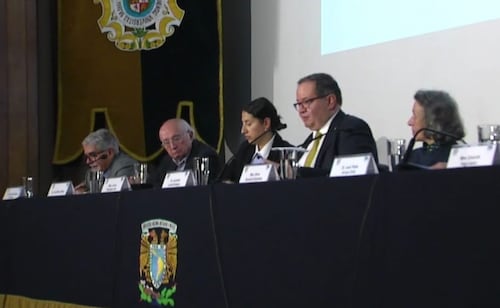
UNAM Rector Leonardo Lomelí Vanegas pushed back against the idea that the university’s Faculty of Economics simply followed Mexico’s dominant economic model. Speaking at a ceremony marking 50 years since the former National School of Economics became a faculty, he said the country experienced low growth during at least 44 of the past 50 years.
Lomelí attributed that period to the predominance of neoliberal-style policies, which he described as producing slow and unstable progress in the national economy. But he argued that the faculty itself had not accepted that approach without criticism.
“Assuming that the Faculty aligned itself with the dominant model during these years is simply to ignore the history of the Faculty, particularly that of the Division of Graduate Studies,” he said. He added that the division had been especially critical of the direction of economic policy.
Assuming that the Faculty aligned itself with the dominant model during these years is simply to ignore the history of the Faculty, particularly that of the Division of Graduate Studies.
The rector said the institution had continued a tradition established when economics became a university program: training economists who could contribute to Mexico’s development. “The Faculty has always proposed alternatives; the fact that they did not listen to us is another story, and we will surely continue doing so because it is part of our role as a public institution,” he said.
Lomelí said public universities must debate reality, develop their own interpretations of national problems and seek options for the country’s development. He traced the faculty’s origins to 1929, when economics became a program within the National School of Jurisprudence. The program faced low demand and disputes over its future, including proposals to close it temporarily and send students abroad for training.
Jesús Silva Herzog helped defend the program’s continuation, arguing that Mexico already had enough self-taught economists to train new professionals. The program became the National School of Economics in 1935, and it took another 41 years to receive faculty status.
The Faculty has always proposed alternatives; the fact that they did not listen to us is another story, and we will surely continue doing so because it is part of our role as a public institution.
About this summary
Originally published by El Universal in Spanish. Translated, summarized, and contextualized automatically by DistantNews, with a note on how the source frames the story. Not individually reviewed before publishing. How this works.
More Stories



From Our Blog

What Press Freedom Means for the News You Read

What Gets Lost (and Found) When News Is Translated

The Critical Role of Diaspora Media in Global News

What Travellers Should Know About Countries with Restricted Press

A Digital Nomad's Guide to Following Local News
