


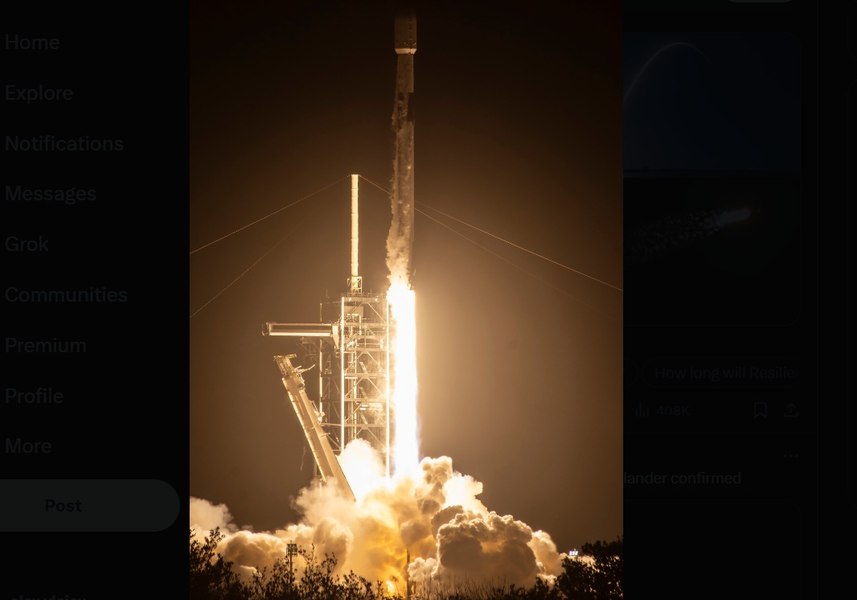
Uncontrolled SpaceX Rocket Stage to Impact Moon Next Week, Creating Crater
Translated from Romanian, summarized and contextualized by DistantNews.
At a glance
News
From a news agency
Ongoing story
- An out-of-control SpaceX Falcon 9 rocket upper stage is set to impact the Moon next week.
- The rocket, launched in January 2025 to deliver two lunar modules, is traveling at over 8,700 km/h.
- The impact is expected to create a crater approximately 27 meters in diameter, highlighting the growing issue of space debris.
An errant upper stage of a SpaceX Falcon 9 rocket, left uncontrolled in orbit after launching two lunar modules in January 2025, is on a collision course with the Moon. The impact is scheduled for next week, according to reports.
The rocket stage is projected to strike the lunar surface at an estimated speed of over 8,700 km/h. The collision is anticipated to occur near the Einstein crater, located on the Earth-facing side of the Moon. Experts predict the impact will excavate a crater roughly 27 meters in diameter and about 5 meters deep. The event is also expected to eject a significant amount of dust and rock fragments into space, which could be observable through telescopes for several tens of minutes.
While the event itself does not pose a direct risk, scientists are using it to draw attention to the increasing problem of space debris in lunar orbits. This issue is gaining importance as space agencies and private companies prepare for new robotic missions and future crewed bases on the Moon.
The SpaceX rocket stage was carrying two private lunar modules: "Blue Ghost," developed by the American company Firefly Aerospace, which achieved the first fully successful private lunar landing, and a module from Japan's ispace, which unfortunately crashed during its landing attempt. NASA and South Korea's Danuri probe will monitor the area before and after the impact to analyze its effects and how the ejected material behaves in the lunar environment. The data gathered could help assess the risks such incidents might pose to future missions and human infrastructure on the Moon.
DistantNews Editorial
Originally published by Adevărul in Romanian. Translated, summarized, and contextualized by our editorial team with added local perspective. Read our editorial standards.
More Stories



From Our Blog

What Gets Lost (and Found) When News Is Translated

The Critical Role of Diaspora Media in Global News

What Travellers Should Know About Countries with Restricted Press

A Digital Nomad's Guide to Following Local News

How the Same Story Looks Different in Different Countries
