


UNIST, Seoul National University Develop 'Electronic Eye' Capable of Precisely Distinguishing Texture and Material Differences
Translated from Korean, summarized and contextualized by DistantNews.
At a glance
News
Sources not specified
New plan
- South Korean researchers have developed a high-performance near-infrared circularly polarized light sensor, capable of distinguishing material textures and properties.
- The sensor utilizes a novel process to align chiral organic semiconductor molecules, overcoming limitations of existing technologies.
- This advancement is expected to be a key technology for next-generation optoelectronic industries, including autonomous driving, bio-imaging, and optical communications.
A joint research team from the Ulsan National Institute of Science and Technology (UNIST) and Seoul National University has developed a groundbreaking near-infrared circularly polarized light sensor. This advanced sensor boasts the world's highest level of performance, enabling it to precisely distinguish not only the shape of objects but also differences in their material textures and properties.
The breakthrough was achieved by applying a new process that aligns chiral organic semiconductor molecules to a single-crystal level. This method overcomes the limitations of previous technologies, where molecular arrangement was not sufficiently dense, leading to reduced electrical performance and detection accuracy. The research, published in the journal Advanced Science, is anticipated to become a core technology for next-generation optoelectronic industries.
Circularly polarized light sensors differentiate between left- and right-rotating polarized light, converting it into electrical signals. While conventional cameras capture shape and color, these sensors can gather more detailed information, such as surface texture, material composition, and the structure of biomolecules. This capability makes them crucial for emerging fields like autonomous driving, medical imaging, and security technologies.
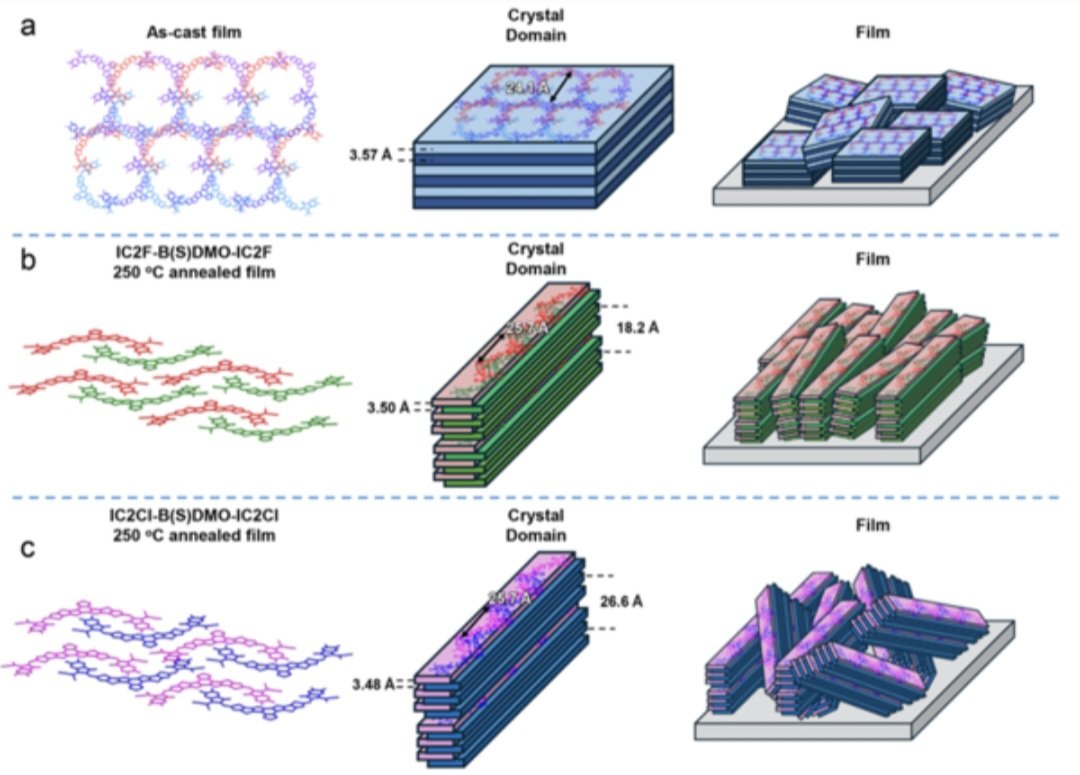
The molecular end atom type and heat treatment conditions systematically elucidated the influence on the molecular arrangement and circular polarization selectivity of the thin film.
The research team successfully fabricated a chiral organic semiconductor thin film using molecules with fluorine at the ends of their helical asymmetric structure. A subsequent heat treatment process at 250 degrees Celsius realigned the molecular structure into a "quasi-2D planar" configuration, approaching single-crystal density. This enhancement significantly improved the light absorption selectivity by more than three times, and the researchers discovered they could even control the rotation direction of the polarized light by altering the heat treatment conditions.
This newly developed sensor achieved a photo-current asymmetry index of 0.1 in the 850-nanometer near-infrared range. It also demonstrated a detectivity of 4.9×10¹¹ Jones and an external quantum efficiency of up to 909%, with a response time under 600 microseconds. These results represent the highest performance levels reported to date for near-infrared circularly polarized light detectors, paving the way for applications in autonomous vehicles, bio-imaging, optical communications, and secure encryption systems.
This study presents a post-processing standard for high-performance chiral optoelectronic devices, and it is expected to be utilized in various fields requiring precise polarization information, such as near-infrared sensors for autonomous driving, bio-imaging, optical communications, and encryption security.
DistantNews Editorial
Originally published by Dong-A Ilbo in Korean. Translated, summarized, and contextualized by our editorial team with added local perspective. Read our editorial standards.
More Stories



From Our Blog

What Gets Lost (and Found) When News Is Translated

The Critical Role of Diaspora Media in Global News

What Travellers Should Know About Countries with Restricted Press

A Digital Nomad's Guide to Following Local News

How the Same Story Looks Different in Different Countries
