

US carrier redeployment leaves Pacific vulnerable as China grows bolder
Translated from Spanish, summarized and contextualized by DistantNews.
At a glance
News
Named sources
Context piece
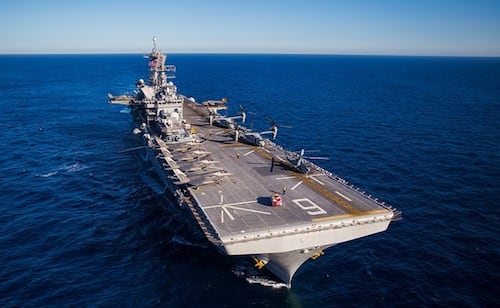
- The US Navy is redeploying the USS George Washington aircraft carrier from the Pacific to the Middle East to support operations against Iran.
- This redeployment leaves the western Pacific without a key US naval asset, potentially creating a vacuum that China could exploit.
- Analysts suggest this shift highlights the strain on US naval resources due to prolonged operations against Iran and a potential pivot by the Trump administration towards the Western Hemisphere.
The US Navy's decision to redeploy the USS George Washington aircraft carrier from the Pacific to the Middle East to bolster operations against Iran is creating significant ripples. This move leaves the western Pacific without a crucial US naval presence, a situation analysts warn could embolden China's assertiveness in the region.
The USS George Washington is expected to replace the USS Abraham Lincoln in the Middle East. The Lincoln's deployment has already been extended beyond its original return date due to escalating tensions with Iran. Concerns about sailor mental health and onboard supply issues have also been cited as reasons for the George Washington's redeployment.
The government says the Pacific is supposedly the most important thing after the Western Hemisphere. Instead, the United States is doing the exact opposite of its previously stated goal of withdrawing from the Middle East.
While the US Navy might deploy another carrier to the Pacific within two months, the current absence highlights the strain on American sailors engaged in indefinite operations. Analysts like Greg Poling from the Center for Strategic and International Studies note that this redeployment contradicts the stated US goal of reducing its Middle East presence and focusing on the Asia-Pacific.
This unpredictability unsettles US allies in the Pacific. Meanwhile, Beijing is reportedly pleased with the distraction, seeing it as an opportunity to enhance its regional influence. China views the US military presence as a hindrance to its ambitions, including the potential annexation of Taiwan. The absence of a US carrier provides China with a chance to project power and signal to regional nations that the US can no longer guarantee their security, according to defense analyst Bryan Clark.
They are using this as part of the narrative to show the Philippines, Japan, Indonesia, and others that the United States is no longer the top dog in the western Pacific. They would simply prefer countries in the region decide that China is the greater power and the United States can no longer guarantee their security.
DistantNews Editorial
Originally published by El Universal in Spanish. Translated, summarized, and contextualized by our editorial team with added local perspective. Read our editorial standards.
More Stories


From Our Blog

What Press Freedom Means for the News You Read

What Gets Lost (and Found) When News Is Translated

The Critical Role of Diaspora Media in Global News

What Travellers Should Know About Countries with Restricted Press

A Digital Nomad's Guide to Following Local News
