


US Marines conduct first attack drone live-fire drill in South Korea
Translated from Korean, summarized and contextualized by DistantNews.
At a glance
News
Named sources
New plan
- U.S. Marines conducted their first-ever live-fire exercise with attack drones in Pocheon, South Korea, as part of joint training.
- The exercise featured the "Neros Archer" loitering munition, capable of precise targeting at long ranges.
- The training aims to demonstrate and enhance the combined defense posture between the U.S. and South Korea.
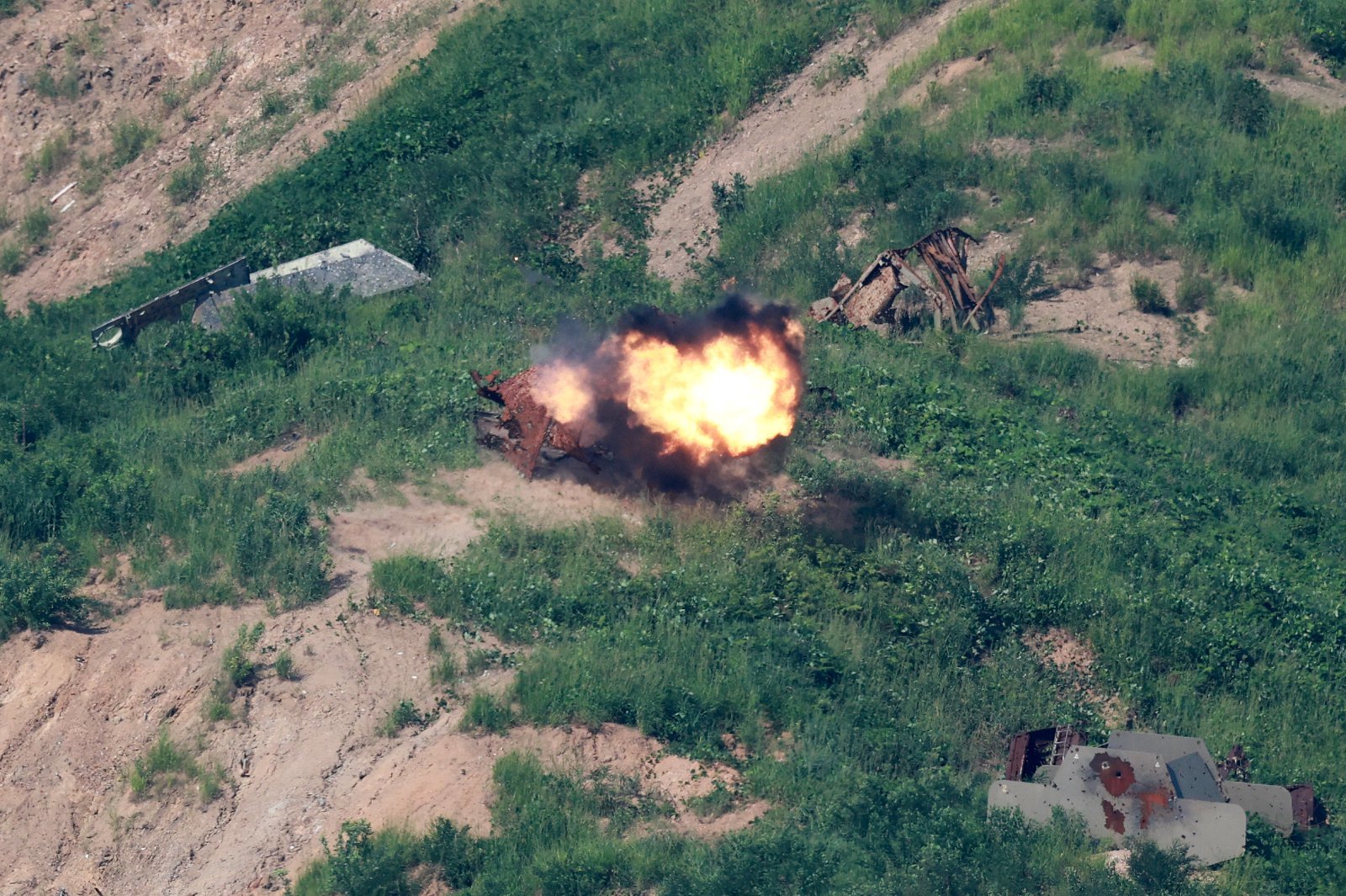
U.S. Marines stationed in Japan conducted their first public live-fire exercise using first-person view (FPV) attack drones on South Korean soil. The training took place on August 5th at the Rodriguez Training Area in Pocheon, Gyeonggi Province, amidst sweltering heat exceeding 37 degrees Celsius. This demonstration is part of the annual Korean Marine Exchange Program (KMEP) between the U.S. and South Korean Marine Corps, which runs from July 28 to August 8.
The exercise showcased the "Neros Archer," a quadcopter-style suicide drone. Participants controlled the drone in real-time via goggles, experiencing a virtual flight from within the aircraft. The drones successfully hit targets approximately 0.9 kilometers away with precision, utilizing their cameras for guidance right up to the point of impact. This capability allows for remote observation of the flight path through a terminal.
The core of everything is the combined readiness of the U.S. and ROK forces. The fact that the U.S. Marines can showcase these capabilities here, on the ground in Korea, in terrain they might actually operate in, is a great opportunity.
Each Neros Archer drone costs around 7 million won and has a maximum range of 25 kilometers, with a top speed of 130 kilometers per hour. It can carry a payload of up to 3 kilograms, including anti-tank, anti-material, or anti-personnel munitions. The anti-tank capability is sufficient to penetrate 100 millimeters of standard tank armor. U.S. Marines are reportedly using these drones for long-range reconnaissance and precision strikes, extending their operational reach beyond the typical range of infantry rifles.
Colonel Peter Ankeny, Deputy Commander of U.S. Marine Corps Forces Korea, emphasized the importance of the joint readiness. "The core of everything is the combined readiness of the U.S. and ROK forces," he stated. "The fact that the U.S. Marines can showcase these capabilities here, on the ground in Korea, in terrain they might actually operate in, is a great opportunity." The 3rd Marine Division, based in Okinawa, Japan, serves as a reinforcement unit for the Korean Peninsula during contingencies. This specific exercise involved personnel from the 7th Regiment of the 3rd Marine Division, temporarily deployed for the training.
The weather on the battlefield doesn't always go our way. Experiencing the terrain, as well as the high heat and humidity of the Korean summer and the harsh winter cold, is a valuable opportunity.
DistantNews Editorial
Originally published by Hankyoreh in Korean. Translated, summarized, and contextualized by our editorial team with added local perspective. Read our editorial standards.
More Stories


From Our Blog

What Gets Lost (and Found) When News Is Translated

The Critical Role of Diaspora Media in Global News

What Travellers Should Know About Countries with Restricted Press

A Digital Nomad's Guide to Following Local News

How the Same Story Looks Different in Different Countries
