

US pulls last aircraft carrier from Asia as Trump focuses on Iran and Western Hemisphere. How China could profit
Translated from Romanian, summarized and contextualized by DistantNews.
At a glance
Analysis
Named sources
Context piece
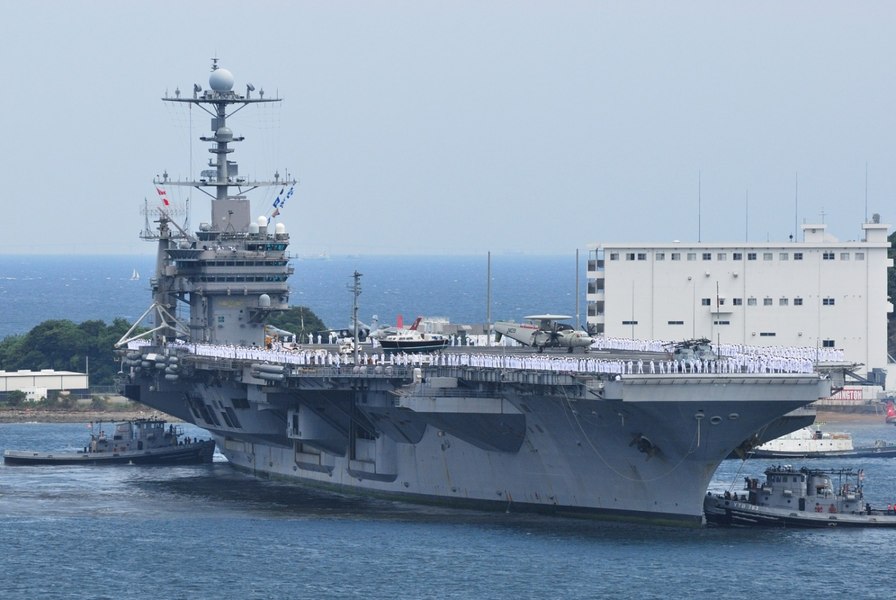
- The U.S.S. George Washington aircraft carrier is leaving the Western Pacific to replace the U.S.S. Abraham Lincoln in the Middle East.
- This redeployment strains U.S. naval resources, which are heavily engaged in operations against Iran.
- Analysts suggest China may exploit the temporary absence of a U.S. carrier to assert its influence in the region.
The U.S.S. George Washington aircraft carrier is being redeployed from the Western Pacific to the Middle East, a move that analysts say could create strategic opportunities for China. The carrier will replace the U.S.S. Abraham Lincoln, which has had its deployment extended to support operations against Iran.
The administration claims the Pacific region should be the second priority, immediately after the Western Hemisphere.
This shift highlights the significant strain on U.S. naval assets, which are increasingly occupied with operations against Iran. The extended mission of the Abraham Lincoln, originally scheduled to return in May, underscores the demands placed on sailors involved in open-ended operations. The U.S.S. George Washington's departure leaves the Western Pacific temporarily without a key carrier.
While the U.S. Navy may deploy another carrier in the coming months, the current situation reflects the Trump administration's pivot towards the Western Hemisphere and away from the Asia-Pacific region, contrary to stated goals of reducing involvement in the Middle East. Greg Poling, director of the Southeast Asia Program at the Center for Strategic and International Studies, noted that allies in the Pacific are concerned about the administration's unpredictability.
In reality, they are doing the exact opposite of the previously stated goal of withdrawing from the Middle East.
Beijing, meanwhile, is reportedly pleased by the distraction of U.S. attention and the frustration among American allies. China views the U.S. military presence as a threat to its rise and an obstacle to its ambitions regarding Taiwan. While an invasion of Taiwan is not anticipated solely due to the carrier's absence, it provides Beijing an opportunity to project power and advance its narrative that the United States is no longer the dominant force in the Western Pacific.
They use this as part of a narrative to show the Philippines, Japan, Indonesia, and other states in the region that the United States is no longer the principal power in the Western Pacific.
DistantNews Editorial
Originally published by Adevărul in Romanian. Translated, summarized, and contextualized by our editorial team with added local perspective. Read our editorial standards.
More Stories

From Our Blog

What Gets Lost (and Found) When News Is Translated

The Critical Role of Diaspora Media in Global News

What Travellers Should Know About Countries with Restricted Press

A Digital Nomad's Guide to Following Local News

How the Same Story Looks Different in Different Countries
