


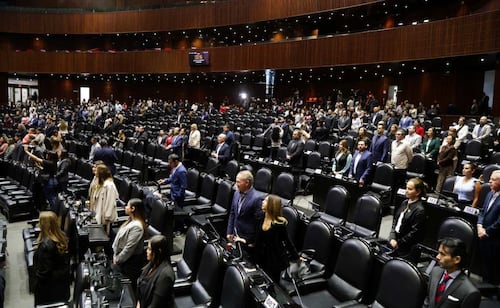
US rejection of T-MEC renewal worries Mexican lawmakers; opposition warns of government's 'lack of strategic anticipation'
Translated from Spanish, summarized and contextualized by DistantNews.
At a glance
News
Named sources
New plan
- US rejection of automatic T-MEC renewal has concerned Mexican lawmakers.
- The treaty's duration is effectively reduced to 10 years, with annual reviews, instead of the desired 16.
- Opposition lawmakers criticize the government's lack of strategic anticipation regarding the treaty's future.
The United States' refusal to automatically renew the Trade Agreement between Mexico, the United States, and Canada (T-MEC) has sparked concern among federal deputies in Mexico, who warn of future risks and negative impacts. Ricardo Monreal, coordinator for Morena in the Chamber of Deputies, explained that the U.S. decision means the treaty will now be reviewed annually and effectively lasts for 10 years, rather than the 16 years initially sought by Mexico and Canada.
Only that it will be reviewed year by year, but the Treaty does not end, it continues for another 10 years because that is how it was signed six years ago.
Monreal noted that the U.S. had proposed 54 modifications to the treaty, covering issues such as the vaquita marina and piracy, while Mexico presented 13 cases for amendment, including the Section 232 tariffs on Mexican products. He also pointed to Donald Trump's known opposition to the T-MEC, urging consideration of the agreement's positive economic effects and the benefits it has brought to the three nations. "Trump does not sympathize with the T-MEC, however, the economic factors and the people who have benefited from the T-MEC think differently," Monreal stated.
Trump does not sympathize with the T-MEC, however, the economic factors and the people who have benefited from the T-MEC think differently; therefore, I believe it is important that this position be made known so that uncertainty is not generated.
He expressed that the ideal scenario would have been an extension until 2042, as requested by Mexico and Canada. Since consensus for the 16-year extension was not reached, the treaty will continue for another 10 years with annual reviews, potentially leading to renewal after 2036. "But, the treaty's expiration date is 2036," Monreal clarified.
The decision of the US not to automatically extend the T-MEC for 16 years in today's review is not the end of the treaty, but it does reveal a lack of strategic anticipation by the federal government.
Héctor Saúl Téllez Hernández, vice-coordinator for economic affairs for the PAN party in the Chamber of Deputies, criticized the federal government's handling of the situation. He stated that the U.S. decision reflects a "lack of strategic anticipation" by the Mexican government. "We knew about Article 34.7 of the treaty since 2018. Arriving at July 1 without a clean extension is a risk that should have been avoided," Téllez Hernández warned.
We knew about Article 34.7 of the treaty since 2018. Arriving at July 1 without a clean extension is a risk that should have been avoided.
DistantNews Editorial
Originally published by El Universal in Spanish. Translated, summarized, and contextualized by our editorial team with added local perspective. Read our editorial standards.
More Stories

From Our Blog

What Press Freedom Means for the News You Read

What Gets Lost (and Found) When News Is Translated

The Critical Role of Diaspora Media in Global News

What Travellers Should Know About Countries with Restricted Press

A Digital Nomad's Guide to Following Local News
