


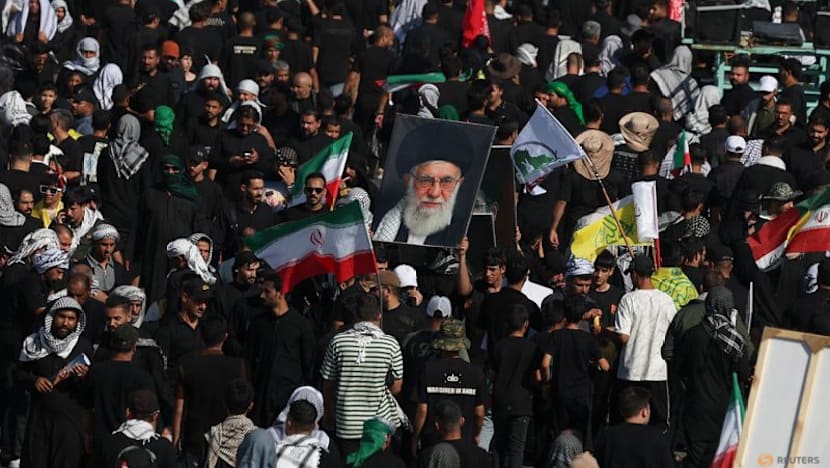
Vast crowds mourn Khamenei in Iraq's holy cities
Summarized and contextualized by DistantNews.
At a glance
News
From a news agency
Context piece
- Massive crowds gathered in Iraq's holy cities of Najaf and Karbala to mourn Iran's slain supreme leader Ali Khamenei.
- The funeral procession is part of six days of ceremonies across Iran and Iraq ahead of Khamenei's burial in Mashhad.
- The ceremonies aim to project strength and unity for the Islamic republic following the recent Middle East war.
Vast crowds filled the streets of Iraq's holy cities on Wednesday, July 8, 2026, to mourn Iran's slain supreme leader Ayatollah Ali Khamenei. Mourners gathered at the Imam Ali shrine in Najaf, where they carried Khamenei's coffin and many attempted to touch it. Karim Hassan, an attendee in Najaf, called Khamenei's death "a calamity, a tragedy" and the funeral ceremonies "a fitting tribute" to "a leader who cannot even be described."
In Karbala, mourners waved Iranian flags and held portraits of Khamenei as they awaited the coffin. The procession is part of six days of funeral ceremonies that began in Iran on Saturday. The Islamic republic dedicated a day to Iraq, a Shia powerhouse with close ties to Tehran.
a calamity, a tragedy
The marathon ceremonies, which started in Tehran and passed through Qom, will conclude with Khamenei's burial on Thursday in his hometown of Mashhad. Iran hopes these events will project strength and unity after the Middle East war, which began with US-Israeli strikes that killed Khamenei and relatives on February 28. Despite the scorching heat, crowds filled Najaf's streets, with clerics holding prayers over Khamenei's remains at the Imam Ali shrine. The coffin then traveled by land to Karbala, where mourners had gathered early, some arriving a day prior, to secure spots near the sacred sites. Water sprinklers offered some relief as chants praising the Islamic republic and its "axis of resistance" leaders echoed from loudspeakers.
are a fitting tribute to a leader who cannot even be described
DistantNews Editorial
Originally published by CNA. Summarized and contextualized by our editorial team with added local perspective. Read our editorial standards.
More Stories



From Our Blog

What Gets Lost (and Found) When News Is Translated

The Critical Role of Diaspora Media in Global News

What Travellers Should Know About Countries with Restricted Press

A Digital Nomad's Guide to Following Local News

How the Same Story Looks Different in Different Countries
