

Washington's Questionnaire: Romania Enters a New American Strategic Examination
Translated from Romanian, summarized and contextualized by DistantNews.
At a glance
Analysis
Named sources
Context piece
- The U.S. administration has sent a questionnaire to NATO allies, seeking to assess their military, political, economic, and operational utility.
- The document, titled 'Questions for NATO Allies & Other Key Stakeholders,' inquires about support for U.S. foreign policy, base access, and arms purchases.
- This evaluation coincides with the Pentagon's review of its military presence in Europe, signaling a potential shift towards a more transactional alliance.
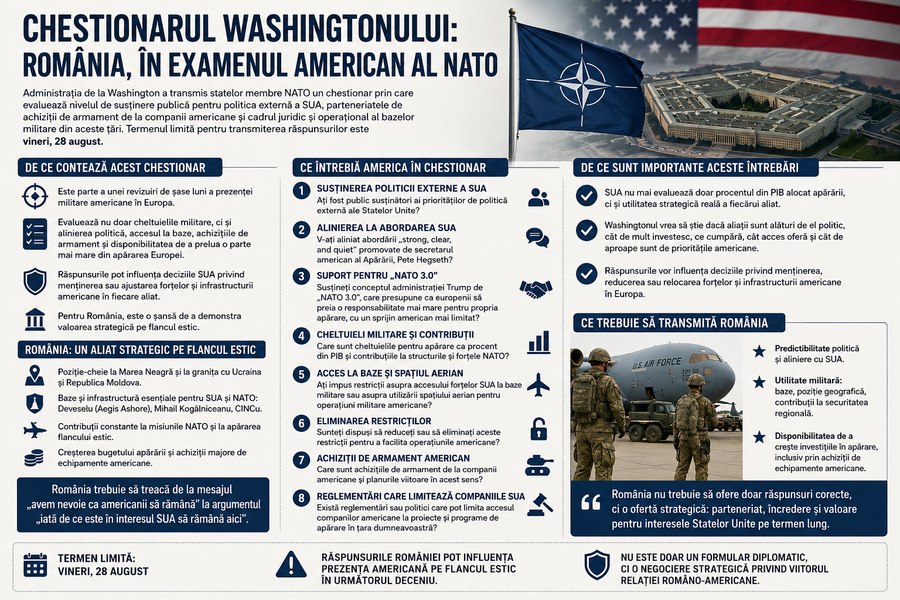
The U.S. administration has distributed a three-page questionnaire to NATO allies, a document that goes beyond a typical bureaucratic exercise. Titled 'Questions for NATO Allies & Other Key Stakeholders,' it probes not only the military value of each ally but also their political, economic, and operational usefulness to the United States. This comprehensive assessment is occurring precisely as the Pentagon reassesses its military footprint in Europe.
The questionnaire, initially reported by Bloomberg, includes specific questions such as whether a nation has publicly supported U.S. foreign policy priorities, imposed restrictions on the use of its bases by American forces, and if it is willing to remove such restrictions. It also asks about arms purchases from U.S. industry and alignment with U.S. approaches described as 'strong, clear, and quiet.' While the U.S. has always evaluated its allies and negotiated base access, the current approach consolidates these criteria into a single assessment tool.
This shift marks a paradigm change, moving from a historically geography- and threat-based alliance to a more transactional model. Under the Trump administration, factors like financial contributions, purchases of American weaponry, unrestricted base access, and public support for Washington's policies have gained prominence. This evaluation is happening amid a six-month review of U.S. military bases and posture in Europe, part of a concept termed 'NATO 3.0' by Defense Secretary Pete Hegseth, which suggests Europeans should assume greater responsibility for their own defense with potentially reduced U.S. support.
While the questionnaire does not explicitly link U.S. military presence to political loyalty, its existence and content suggest a re-evaluation of alliance dynamics. The questions aim to determine an ally's utility beyond mere geographical positioning, reflecting a strategic adjustment in how Washington views its partnerships in Europe.
DistantNews Editorial
Originally published by Adevărul in Romanian. Translated, summarized, and contextualized by our editorial team with added local perspective. Read our editorial standards.
More Stories


From Our Blog

What Gets Lost (and Found) When News Is Translated

The Critical Role of Diaspora Media in Global News

What Travellers Should Know About Countries with Restricted Press

A Digital Nomad's Guide to Following Local News

How the Same Story Looks Different in Different Countries
