


Drones no longer wait for tenders: Romania's race for its own anti-drone shield
Translated from Romanian, summarized and contextualized by DistantNews.
At a glance
Analysis
Sources not specified
Context piece
- Romania is seeking to develop its own anti-drone defense capabilities, learning from the war in Ukraine.
- The article criticizes a tendency to view the private sector as a secondary supplier rather than a strategic partner in defense.
- Romania must prioritize domestic production and technological adaptation to ensure security, rather than relying solely on expensive foreign imports.
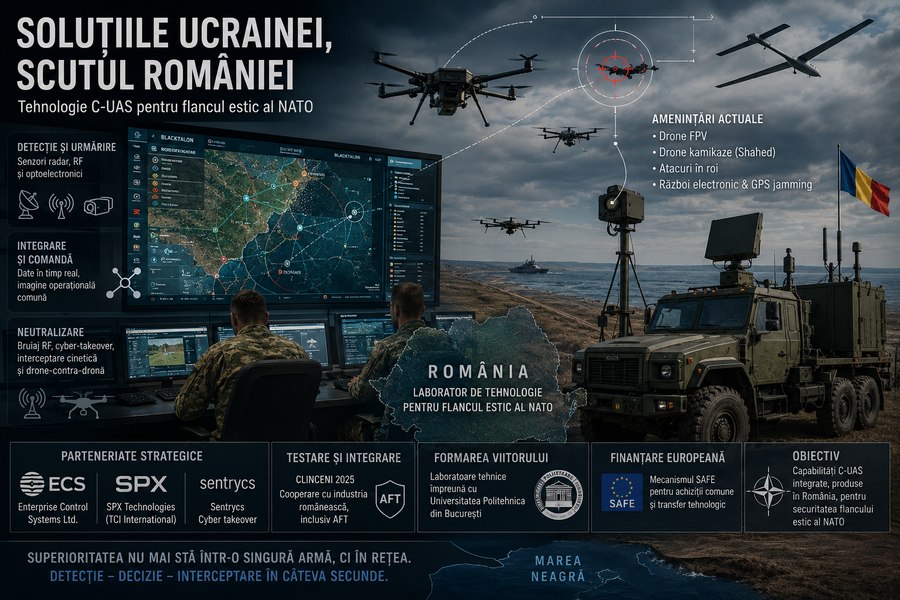
Romania is striving to build its own anti-drone defense capabilities, a strategic imperative highlighted by the ongoing war in Ukraine. The conflict underscores that future defense relies not on single weapons, but on integrated networks connecting sensors, software, and interceptors. Romania aims to translate this lesson into a domestic technological and industrial advantage.
The article criticizes a persistent mindset within parts of Romania's political and administrative class that relegates the private sector to a "second-hand supplier" role. Companies and engineers capable of developing defense solutions are often only considered after major contracts are awarded and crises emerge. This approach ignores the agility and rapid adaptation demonstrated by small and medium-sized enterprises during critical situations.
If Bucharest continues to equate security with importing costly platforms and overlooks its own private sector's potential for rapid production, integration, and adaptation, it risks facing real crises with contracts but no autonomy, budgets but no speed. Most critically, it risks failing to leverage its own skilled workforce as a strategic asset.
The Ministry of National Defense and the Government should establish a permanent mechanism for Romanian private companies, universities, and the military to rapidly test anti-drone and electronic warfare technologies in operational settings. Solutions that prove effective should quickly move to procurement and production. The SAFE program, for instance, should facilitate technology transfer, intellectual property development, and domestic production capacity, not just the purchase of Western systems.
The core lesson from Ukraine is that in a crisis, the winning state is not the one with the most bureaucratic procurement process, but the one that can swiftly connect its military with engineers, industry, and research to turn today's problems into tomorrow's solutions. Relying on external producers during prolonged conflict means prioritizing their national needs. Romania cannot build its security on the assumption that others will always supply its deficiencies. The nation must decide whether to remain a client of foreign defense industries or become its own security provider, at least in areas where it possesses expertise.
DistantNews Editorial
Originally published by Adevărul in Romanian. Translated, summarized, and contextualized by our editorial team with added local perspective. Read our editorial standards.
More Stories


From Our Blog

What Gets Lost (and Found) When News Is Translated

The Critical Role of Diaspora Media in Global News

What Travellers Should Know About Countries with Restricted Press

A Digital Nomad's Guide to Following Local News

How the Same Story Looks Different in Different Countries
