


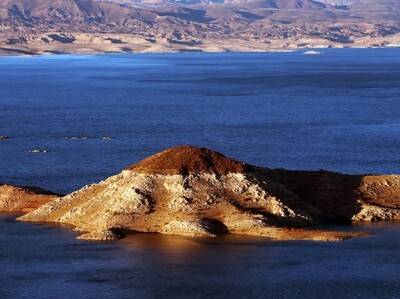
Water crisis in the U.S. Southwest and its impact on Mexico
Translated from Spanish, summarized and contextualized by DistantNews.
At a glance
News
Named sources
Context piece
- Critically low water levels in the Powell and Mead reservoirs threaten the U.S. Southwest and impact Mexico due to the Colorado River basin drought.
- The U.S. government is implementing water supply cuts for Arizona, California, and Nevada to protect the system, a move criticized by some for lacking long-term ambition.
- Indigenous communities in the U.S. are protesting their limited role in water management decisions, while Mexico faces repercussions under a 1944 water treaty.
The U.S. Southwest faces a severe water crisis as the Powell and Mead reservoirs, vital to supplying at least seven states, have hit historic lows amid a prolonged drought in the Colorado River basin.
The U.S. government is finalizing a plan to reduce water allocations to Arizona, California, and Nevada to safeguard the nation's largest water infrastructure. California Governor Gavin Newsom supported the measure but criticized the administration's short-term approach, advocating for equitable responsibility sharing among the seven affected states based on the river's new reality.
Any long-term solution must share responsibility equitably among the seven states, recognizing the new reality of the Colorado River.
With the system at historic lows, the region faces seven critical months until the spring snowmelt replenishes the basin. Jack Schmidt, director of the Colorado River Studies Center at Utah State University, expressed uncertainty about the coming winter, noting that even with an anticipated El Niño bringing stronger rains, "inflow volumes will be below normal next year."
We are barely in August and we have no idea what next winter will bring.
The crisis disproportionately affects Indigenous communities in the U.S., who argue that their limited participation in water management decisions marginalizes their populations. Rebecca Loudbear, attorney general for the Colorado River Indian Tribes (CRIT), stated in a letter that their restricted role "does not reflect the nature or scope of our rights," highlighting that her people hold water rights to over 23% of Arizona's allocation.
Furthermore, the strained capacity of U.S. reservoirs impacts Mexico, which receives water from the Colorado River under a 1944 treaty. The economic repercussions of this water scarcity are significant for both nations, exacerbating existing challenges in the region.
Our limited role in this process does not reflect the nature or scope of our rights.
DistantNews Editorial
Originally published by Diario Libre in Spanish. Translated, summarized, and contextualized by our editorial team with added local perspective. Read our editorial standards.
More Stories
From Our Blog

What Gets Lost (and Found) When News Is Translated

The Critical Role of Diaspora Media in Global News

What Travellers Should Know About Countries with Restricted Press

A Digital Nomad's Guide to Following Local News

How the Same Story Looks Different in Different Countries
