


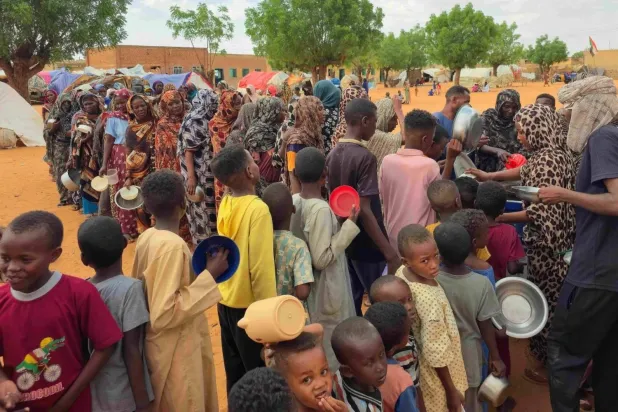
‘We Eat So We Don’t Die’: Daily Life with Hunger in Sudan
Summarized and contextualized by DistantNews.
At a glance
News
Named sources
Context piece
- Daily life in Sudan has been severely disrupted by conflict since April 15, 2023, impacting food, water, and medicine access for families like Nahla Khalifa's.
- Years of economic hardship predated the current fighting, forcing many Sudanese to subsist on minimal meals and communal kitchens.
- The Sudanese pound has collapsed, with its value plummeting against the dollar, drastically increasing the cost of basic goods and eroding purchasing power.
Nahla Khalifa awoke on April 15, 2023, to the sound of artillery in Omdurman. The war that sent her and her five children scrambling under beds and tables upended the most basic aspects of their lives: food, water, and medicine. Initially, the family survived on remaining Ramadan provisions, but supplies were limited. Sudan's economic hardship had begun years before the conflict, with salaries already insufficient for many households.
"We ate simply so we wouldn’t starve to death," Nahla told Asharq Al-Awsat. Meat, milk, vegetables, and fruit vanished from the family’s diet, while even a cup of tea became a luxury. Her children often went to bed hungry and frightened, and her diabetic husband’s health deteriorated amid scarce food and limited access to treatment. More than three years later, Nahla’s experience is no longer merely a reflection of the conflict’s early days. Food shortages have grown into a nationwide emergency, compounded by continued fighting, the collapse of the Sudanese pound, lost livelihoods, and deteriorating public services.
The Sudanese pound recently breached 6,000 to the dollar on the parallel market, compared with rates of 3,500 to 4,000 at bank exchange counters. A currency trader told Asharq Al-Awsat that the pound’s plunge immediately drove up the cost of basic goods as household purchasing power eroded to unprecedented levels. Economist Mohamed al-Nayer noted that the currency had remained relatively stable for about three months before weakening again this week. Inflation, poverty, unemployment, and currency depreciation are predictable consequences of a wartime economy, al-Nayer explained, although the easing of fighting in some areas has allowed limited economic activity to gradually resume.
University of Khartoum economics and finance professor Ibrahim Ahmed Onour sees deeper structural problems behind the pound’s decline, pointing to the absence of effective monetary policy and weak coordination with fiscal policy. He explained that limited central bank tools have left the exchange rate vulnerable to parallel-market speculation, while any sustained recovery in the pound hinges partly on controlling Sudan’s gold resources. Official production reached about 70 tons last year, while declared exports amounted to only 20 tons. Curbing smuggling and allowing the central bank to retain some output as reserves could bolster the currency, while the widening gap between official and parallel-market rates risks affecting remittances from Sudanese abroad.
We ate simply so we wouldn’t starve to death.
DistantNews Editorial
Originally published by Asharq Al-Awsat. Summarized and contextualized by our editorial team with added local perspective. Read our editorial standards.
More Stories


From Our Blog

What Gets Lost (and Found) When News Is Translated

The Critical Role of Diaspora Media in Global News

What Travellers Should Know About Countries with Restricted Press

A Digital Nomad's Guide to Following Local News

How the Same Story Looks Different in Different Countries
