


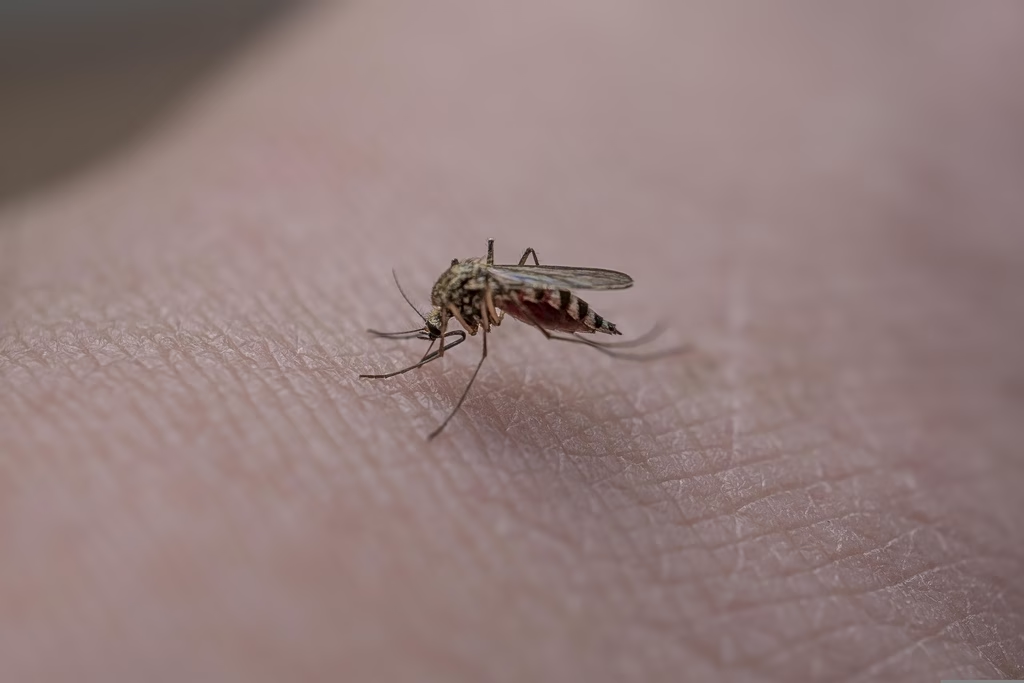
West Nile Virus prompts emergency mosquito spraying in Kordelio-Evosmos, Greece
Translated from Greek and summarized by DistantNews. Read the original for the full story.
At a glance
News
Named sources
Ongoing story
- The municipality of Kordelio-Evosmos is undertaking emergency mosquito spraying due to the detection of West Nile Virus cases in a neighboring area.
- The municipality has been designated a high-risk zone by the Hellenic National Public Health Organization (EODY).
- Greece has reported 232 West Nile Virus cases this year, with the majority in Attica, prompting increased control measures across the region.
The municipality of Kordelio-Evosmos in Greece is launching extensive emergency mosquito spraying operations in response to the detection of West Nile Virus cases in the adjacent municipality of Ampelokipoi-Menemeni. The Hellenic National Public Health Organization (EODY) has classified Kordelio-Evosmos as a high-risk area, necessitating immediate public health interventions.
Municipal services have already begun spraying operations in parks, green spaces, areas with stagnant water, and other potential mosquito breeding grounds. These measures are particularly focused on high-risk zones within the municipality. The decision to intensify spraying comes amid a concerning rise in West Nile Virus cases across the country.
From the moment cases of West Nile Virus were detected in our neighboring municipality, resulting in EODY classifying us as a high-risk area, it is our obligation to take all necessary measures to protect the health of our fellow citizens.
Nationwide, Greece has recorded 232 cases of the virus, with the Athens metropolitan area reporting the highest concentration. In response, the Attica region is bolstering its mosquito control efforts, deploying specialized high-pressure spraying equipment known as "turbines." Regular spraying is also being conducted in high-risk areas by the Municipality of Athens.
The very warm winter we had, especially in Attica, the very wet and rainy spring, which created a lot of stagnant water, and the fact that we likely have many more migratory birds this year.
Experts attribute the current outbreak to a confluence of environmental factors, including a particularly warm winter, a wet and rainy spring that created numerous stagnant water pools, and potentially an increase in migratory birds. The period through mid-September is considered high-risk for virus transmission.
Public health officials are concerned about the possibility of an epidemic similar to 2018, which saw the highest number of cases and tragically resulted in 50 deaths. While it is still too early to make definitive predictions, the course of the virus's spread in September and October will be heavily influenced by weather conditions. Researchers at the National and Kapodistrian University of Athens are also investigating rapid testing methods for the virus.
Epidemiologically, the issue is whether we will reach 2018, when we had the most cases and, unfortunately, 50 deaths proportionally.
About this summary
Originally published by Ta Nea in Greek. Translated, summarized, and contextualized automatically by DistantNews, with a note on how the source frames the story. Not individually reviewed before publishing. How this works.
More Stories


From Our Blog

What Gets Lost (and Found) When News Is Translated

The Critical Role of Diaspora Media in Global News

What Travellers Should Know About Countries with Restricted Press

A Digital Nomad's Guide to Following Local News

How the Same Story Looks Different in Different Countries
