


Whale necropsy confirms female, finds fishing net fragment
Translated from German, summarized and contextualized by DistantNews.
At a glance
News
From a news agency
Context piece
- Experts performing a necropsy on a humpback whale carcass on the Danish island of Anholt have determined the animal was female.
- The whale, nicknamed 'Timmy' or 'Hope,' was found to have a piece of fishing net in its intestines.
- The necropsy aims to determine the cause of death, though experts note it may be difficult to ascertain due to the carcass's condition.
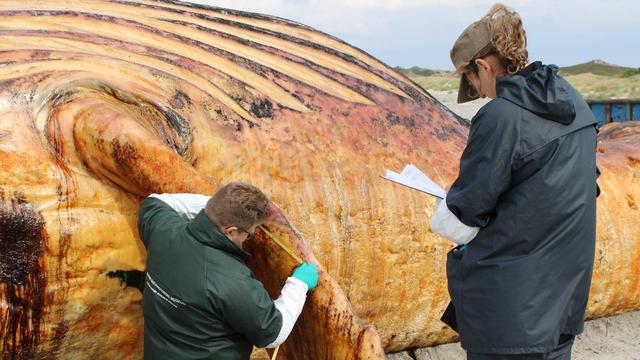
The necropsy of a humpback whale, affectionately known as 'Timmy' or 'Hope,' on the Danish island of Anholt has yielded initial findings, confirming the animal was female. A team of experts carefully examined the yellow-brown carcass, taking measurements and notes. Images captured the process, including the use of a long knife to release gases from the bloated body before it was opened and dissected.
It could already be too late to discover, for example, internal bleeding.
During the examination, a piece of fishing net was discovered within the whale's intestines. The primary goal of the necropsy is to determine the cause of death for the humpback whale, which has been making headlines for weeks. The team also plans to collect skin samples for DNA testing. The entire procedure is expected to take about six hours.
However, pinpointing the exact cause of death may prove challenging. Danish whale researcher Peter Teglberg Madsen noted that it might be too late to detect internal bleeding. Similarly, determining if the whale had ingested water could also be difficult. The presence of fishing nets in its stomach and intestines is considered a potential contributing factor to its demise. The carcass, which has been on the beach for weeks, is significantly decomposed and has been ravaged by seagulls, presenting a difficult scene for onlookers and media.
The whale has been lying in the sun for a very long time and will stink a lot.
Madsen cautioned about potential health risks, stating, "Anyone approaching the whale can contract diseases, viruses, or bacteria. That's why we limit the number of people near the whale and wear protective clothing, aprons, masks, and gloves." Environmental ministries and conservation organizations, including Greenpeace and the German Maritime Museum, are following the necropsy via livestream. The carcass is expected to remain on Anholt for at least another day.
Anyone who approaches the whale can contract diseases, viruses, or bacteria. That's why we limit the number of people near the whale and wear protective clothing, aprons, masks, and gloves.
DistantNews Editorial
Originally published by Der Spiegel in German. Translated, summarized, and contextualized by our editorial team with added local perspective. Read our editorial standards.
More Stories



From Our Blog

What Gets Lost (and Found) When News Is Translated

How the Same Story Looks Different in Different Countries

The Critical Role of Diaspora Media in Global News

What Travellers Should Know About Countries with Restricted Press

A Digital Nomad's Guide to Following Local News
