


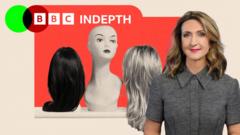
What a hair loss breakthrough could mean for women like me
Summarized and contextualized by DistantNews.
At a glance
In-depth
Sources not specified
Context piece
- A BBC presenter shares a personal account of hair loss during chemotherapy for breast cancer.
- She describes losing her hair as more distressing than a mastectomy, impacting her identity.
- Scientists in Japan have reportedly achieved a breakthrough in recreating the full hair growth cycle in mice, offering hope for reversing hair loss.
Victoria Derbyshire, a presenter for BBC's Newsnight, recounts the profound emotional impact of losing her hair during chemotherapy for breast cancer. She vividly remembers the moment strands of her brown hair began collecting in the bath plug hole, a stark realization after undergoing the first of six chemotherapy sessions.
Oh wow.
Despite using a cold cap, a device intended to minimize hair loss, Derbyshire experienced significant shedding. She reveals that for her, the loss of her hair was more devastating than undergoing a mastectomy. "Without my hair, I wasn't me," she states, emphasizing how integral her hair was to her sense of self and identity, something she hadn't fully grasped until it began to fall out.
This personal narrative gains significance with recent scientific developments. Researchers in Japan, led by Professor Takashi Tsuji, claim a "major breakthrough" in recreating the complete hair growth cycle in mice. This means hair could naturally grow, shed, and regrow over time, mimicking the body's natural processes.
It may sound dramatic, but for me, losing my hair was worse even than losing a breast through a mastectomy.
While transplanted hair can already be grown, replicating follicles that can repeatedly cycle through growth and shedding has been a persistent challenge. This advancement offers a glimmer of hope for millions worldwide, particularly women experiencing hair loss due to cancer treatment, alopecia, or aging. It suggests that reversing hair loss, once considered impossible, may become a reality.
Because without my hair, I wasn't me.
Hair has historically held deep cultural and personal significance, often tied to identity, status, and femininity. From the elaborate wigs of Ancient Egypt to the bobbed styles of the 1920s symbolizing rebellion, hair has consistently been more than just strands on one's head. As psychiatrist Sylvia Karasu notes, "Hair shapes our identity. It is a biological, physiological and social marker of stages of our life."
major breakthrough
DistantNews Editorial
Originally published by BBC News. Summarized and contextualized by our editorial team with added local perspective. Read our editorial standards.
More Stories



From Our Blog

What Gets Lost (and Found) When News Is Translated

The Critical Role of Diaspora Media in Global News

What Travellers Should Know About Countries with Restricted Press

A Digital Nomad's Guide to Following Local News

How the Same Story Looks Different in Different Countries
