



What Does Germany’s AfD Stand For? Who Leads It and How Did It Perform in the Latest Election?
Translated from Turkish and summarized by DistantNews. Read the original for the full story.
At a glance
Explainer
Sources not specified
Outcome reported
- The Alternative for Germany won 43.8% in Saxony-Anhalt, its strongest result in a state election, while the Christian Democratic Union received 17.2%.
- The AfD did not win an absolute majority and therefore could not form a government alone.
- The party supports tighter limits on migration and asylum, stronger national sovereignty, reduced EU powers and market-oriented energy policies; Alice Weidel and Tino Chrupalla are its federal co-leaders.
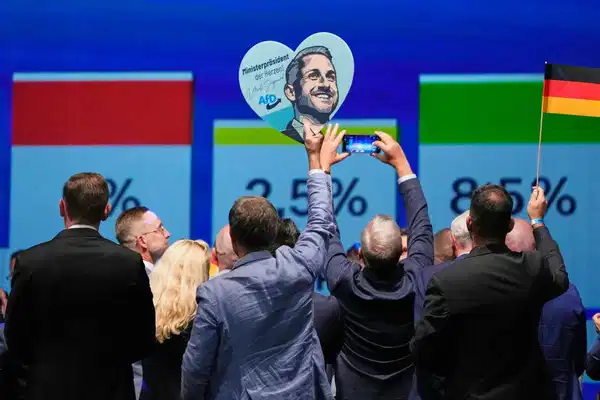
Germany’s far-right Alternative for Germany, or AfD, won 43.8% of the vote in Saxony-Anhalt, more than doubling its 2021 result and recording the strongest showing in the party’s history in a state election.
The result gave the AfD a clear lead over the governing Christian Democratic Union, which received 17.2%, down from 37.1% in 2021. But the AfD did not secure the absolute majority needed to govern on its own. The Social Democratic Party won 9.3%, the Greens 8.9%, Die Linke 8.6% and the Sahra Wagenknecht Alliance 5.3%. The Free Democratic Party received 2.6% and failed to enter the state parliament.
The party is generally described as right-populist and far-right. It presents itself as a movement defending Germany’s national interests, sovereignty and citizens’ security. Its policies include limiting immigration and asylum, strengthening border controls and deporting people who have no right to remain in Germany.
The AfD also calls for more national control over migration policy and greater national sovereignty within the European Union. Its program supports preserving sovereign nation-states and restricting the EU’s powers, while opposing a more centralized European state.
On climate and energy, the party rejects current transformation policies, supports removing some renewable-energy incentives and favors market-based energy policy. Its economic priorities include reducing taxes and bureaucracy, improving German competitiveness and shaping social policy at the national level. The party’s two federal co-leaders are Alice Weidel and Tino Chrupalla. Weidel also served as the AfD’s candidate for chancellor in the 2025 federal election campaign.
About this summary
Originally published by Cumhuriyet in Turkish. Translated, summarized, and contextualized automatically by DistantNews, with a note on how the source frames the story. Not individually reviewed before publishing. How this works.
More Stories
From Our Blog

News in Translation: What Gets Lost, and How We Keep the Framing

Diaspora Media: How Communities Follow News From Home

Traveling Where the Press Is Not Free: How to Read the News There

The Digital Nomad's Guide to Local News

The Same Story, Different Countries: How Coverage Changes at the Border
