

When Satellites Fall Silent: The Ukraine War Lesson Romania's Industry Is Learning
Translated from Romanian, summarized and contextualized by DistantNews.
At a glance
Analysis
Named sources
Context piece
- Romania has developed a transportable tropospheric scatter communication system, offering an independent communication channel vital in modern warfare.
- The system, a revival of Cold War technology, addresses vulnerabilities exposed by electronic warfare in conflicts like the one in Ukraine.
- Its development by a Romanian consortium highlights the growing need for secure, non-satellite communication methods for national defense.
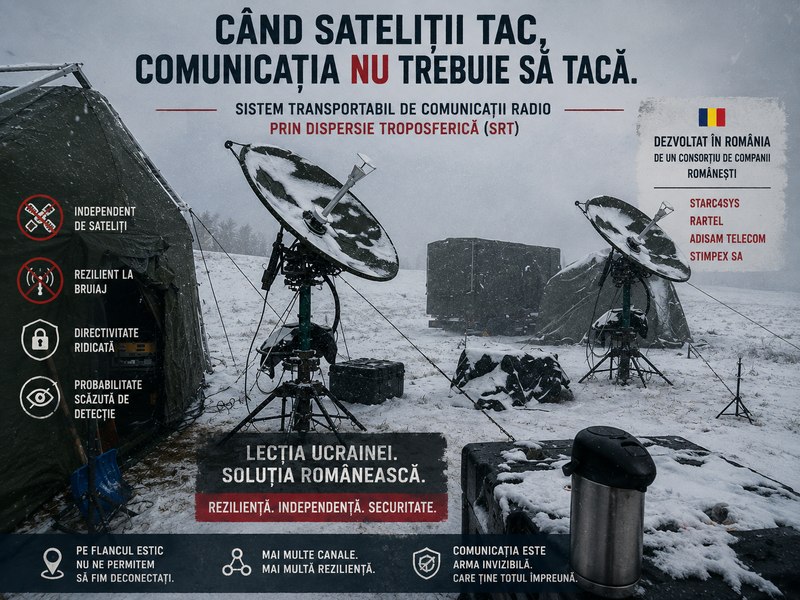
In a world increasingly reliant on satellites and vulnerable to electronic warfare, Romania is looking back to the 1950s for a solution. The country has developed a transportable tropospheric scatter communication system, a technology born during the Cold War. This development, announced by the State Office for Inventions and Trademarks (OSIM), underscores a critical lesson learned from conflicts like the one in Ukraine: communication independence is a weapon in itself.
in a war where the adversary tries to jam, interrupt, or control your communications, the independence of the channels through which information circulates becomes a weapon itself.
The system, dubbed SRT, was developed entirely in Romania by a consortium including STARC4SYS, Rartel, Adisam Telecom, and STIMPEX SA. STARC4SYS managed the project and integrated it into transit cases, while Adisam Telecom brought expertise in satellite communications. Rartel, a subsidiary of Italian entities Leonardo and Thales, contributed industrial know-how, and STIMPEX SA handled advanced manufacturing. The inclusion of external component suppliers from Canada, the U.S., and Sweden highlights the complex global supply chains involved, even in a project aiming for national sovereignty.
For military strategists, particularly those who have observed the conflict in Ukraine, tropospheric scatter communication is far from obsolete. It offers a way to transmit information beyond the line of sight by bouncing radio signals off the lower atmosphere. This method bypasses the need for direct satellite links or continuous terrestrial relays. During the Cold War, NATO relied on similar technology for its ACE High network, ensuring communication resilience even if conventional infrastructure was attacked.
an army can have high-performance drones, long-range missiles, modern radars, and artificial intelligence systems, but all these depend on the ability to transmit information.
The war in Ukraine has starkly demonstrated the fragility of modern communication systems. Russian electronic warfare has targeted and disrupted Ukrainian communications, revealing how dependent advanced military capabilities are on reliable data transmission. The article argues that relying on a single communication channel leaves one vulnerable, whether to an adversary's jamming efforts or a supplier's potential restrictions. This Romanian innovation offers a tangible way to mitigate such risks, providing a robust, independent communication backbone.
who depends on a single communication channel depends, at the critical moment, on the goodwill of someone else, be it the adversary who can jam it, or the supplier who can limit it.
The SRT system represents a strategic pivot, acknowledging that technological superiority in drones, missiles, and AI is meaningless if the information flow is compromised. By reviving and adapting tropospheric scatter technology, Romania is building a more resilient defense posture, learning from the battlefield realities of the 21st century and the technological echoes of the past.
in a war with the Soviet Bloc, the Alliance had to be able to communicate even after conventional infrastructure had been attacked or destroyed.
DistantNews Editorial
Originally published by Adevărul in Romanian. Translated, summarized, and contextualized by our editorial team with added local perspective. Read our editorial standards.
More Stories

From Our Blog

What Gets Lost (and Found) When News Is Translated

The Critical Role of Diaspora Media in Global News

What Travellers Should Know About Countries with Restricted Press

A Digital Nomad's Guide to Following Local News

How the Same Story Looks Different in Different Countries
