


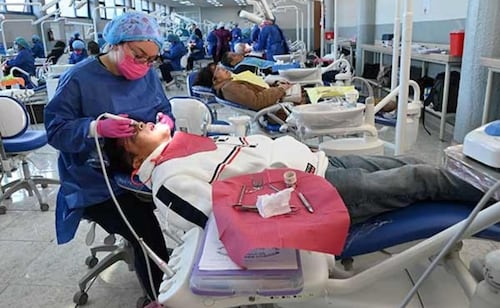
WHO names UNAM center leader in oral health for Latin America, benefiting seniors
Translated from Spanish, summarized and contextualized by DistantNews.
At a glance
News
Sources not specified
New plan
- The World Health Organization designated UNAM's Faculty of Dentistry as a Collaborating Center for Oral Health and Aging.
- The center will focus on developing public policies to improve the quality of life for older adults in Latin America.
- Specialists highlighted the link between oral health and overall well-being, particularly for the elderly.
Mexico City – The National Autonomous University of Mexico (UNAM) has been recognized by the World Health Organization (WHO) as a leading center for oral health in Latin America. The university's Department of Oral Public Health at the Faculty of Dentistry will serve as a WHO Collaborating Center for Oral Health and Aging for the next four years.
For some time we have had a relationship with PAHO and shared an interest in promoting well-being during the Decade of Healthy Aging. The proposal was analyzed by the WHO and finally authorized in Geneva.
This designation will enable UNAM specialists to actively participate in shaping public policies aimed at enhancing the quality of life for older adults. Beyond proposing public health initiatives, the center will also focus on educating seniors and their caregivers about the crucial role of oral hygiene in maintaining overall well-being.
Aída Borges Yáñez, head of the Department of Oral Public Health, explained that the appointment followed a rigorous two-and-a-half-year evaluation process, supported by the Pan American Health Organization (PAHO). "We have had a relationship with PAHO for some time and shared an interest in promoting well-being during the Decade of Healthy Aging. The proposal was analyzed by the WHO and finally authorized in Geneva," she stated.
It is relevant because there is little international work in this field, and it is currently the only Collaborating Center in Latin America focused on aging and oral health.
The project involves academics Erika Heredia Ponce and Laura Bárbara Velázquez Olmedo, along with researcher Sergio Sánchez García, all from the Faculty of Dentistry. Sánchez emphasized that the designation is an international acknowledgment for UNAM, opening doors for participation in global research and collaboration networks. He noted, "It is relevant because there is little international work in this field, and it is currently the only Collaborating Center in Latin America focused on aging and oral health."
Frailty is related to the progressive deterioration of functions such as chewing, swallowing, and tongue mobility, while sarcopenia implies the gradual loss of muscle mass, strength, and physical functionality.
Specialists pointed out a significant challenge: overcoming the perception that oral health can be treated in isolation from the rest of the body. Erika Heredia elaborated that oral diseases and alterations are closely linked to issues affecting older adults, such as frailty and sarcopenia. Frailty relates to the progressive decline in functions like chewing, swallowing, and tongue mobility, while sarcopenia involves the gradual loss of muscle mass, strength, and physical functionality. Laura Bárbara Velázquez added that developing evidence-based public policies will be key to improving both oral health and the quality of life for a broad segment of the population.
The development of evidence-based public policies will allow for the improvement of both oral health and the quality of life for large sectors.
DistantNews Editorial
Originally published by El Universal in Spanish. Translated, summarized, and contextualized by our editorial team with added local perspective. Read our editorial standards.
More Stories


From Our Blog

What Press Freedom Means for the News You Read

What Gets Lost (and Found) When News Is Translated

The Critical Role of Diaspora Media in Global News

What Travellers Should Know About Countries with Restricted Press

A Digital Nomad's Guide to Following Local News
