

Why a sea turtle in Ho Chi Minh City is worshipped as “Madam”
Translated from Vietnamese and summarized by DistantNews. Read the original for the full story.
At a glance
In-depth
Named sources
Context piece
- Shrines in former Vũng Tàu and Long Hải, now part of Ho Chi Minh City, preserve sea turtle bones, graves and spirit tablets.
- Local caretakers describe large turtles that washed ashore as unusual beings and worship one known as Bà Sáu or Bà Lớn.
- A turtle that came ashore in Long Hải in 1974 has its own grave and shrine, while another shrine in Thắng Tam displays bones known as “Madam's remains.”
In parts of Ho Chi Minh City, a sea turtle is not remembered as an animal washed ashore. It is honored as “Madam,” with bones behind an altar, offerings in a shrine and a carefully maintained grave.
At Ông Nam Hải Shrine in Thắng Tam, formerly in Vũng Tàu, an altar to the turtle deity has stood since 1979. A red-covered spirit tablet and a sign reading “Madam's remains” sit before a glass cabinet containing fragments of sea turtle bones. The shell is gone, leaving little to reveal what the pieces once were.
She was very large, as wide as two armfuls. Three ridges on the shell are called Madam Three, and six ridges are called Madam Six. Here, we worship Madam Six.
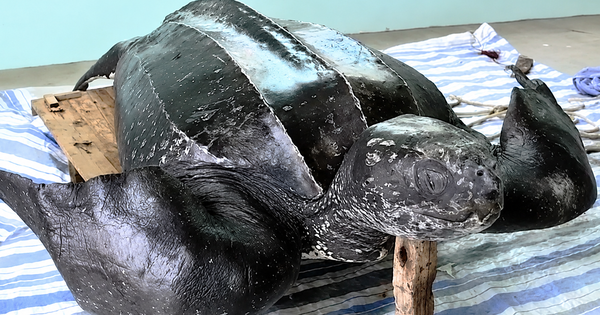
A member of the shrine's ceremonial committee said the turtle was enormous. Turtles with three ridges on their backs are called Bà Ba, or Madam Three, while those with six ridges are called Bà Sáu, or Madam Six. The description points to a leatherback turtle, the world's largest sea turtle, whose soft shell has prominent ridges and whose adults can exceed two meters in length and weigh hundreds of kilograms.
Don't! Taking a close-up picture like that is disrespectful. Madam will punish you.
More than two kilometers from Dinh Cô in Long Hải, another shrine is dedicated to a turtle known as Bà Lớn, or the Great Madam. The shrine honors several religious figures, but Bà Lớn's spirit tablet occupies the most prominent place in the main hall. A glass cabinet holds fragments of her bones, alongside an incense burner, an incense bowl, flowers and fruit.
Trương Thị Kim Ngọc, the 74-year-old caretaker, said the turtle washed ashore near the shrine gate in 1974. She recalled descriptions that it was as large as two tables placed together and that its body expanded further. According to her account, it had no foul smell or flies and bore a swastika, a symbol associated with good fortune. The original earth grave was rebuilt in 2004 with a roof and a pair of cranes, and remains tended by visitors to the shrine.
People said Madam had washed ashore and drifted near the shrine gate. She was very large, as big as two tables put together. When the body swelled, it became even larger, but strangely there was no foul smell and not a single fly.
About this summary
Originally published by Thanh Niên in Vietnamese. Translated, summarized, and contextualized automatically by DistantNews, with a note on how the source frames the story. Not individually reviewed before publishing. How this works.
More Stories

From Our Blog

What Gets Lost (and Found) When News Is Translated

The Critical Role of Diaspora Media in Global News

What Travellers Should Know About Countries with Restricted Press

A Digital Nomad's Guide to Following Local News

How the Same Story Looks Different in Different Countries
