


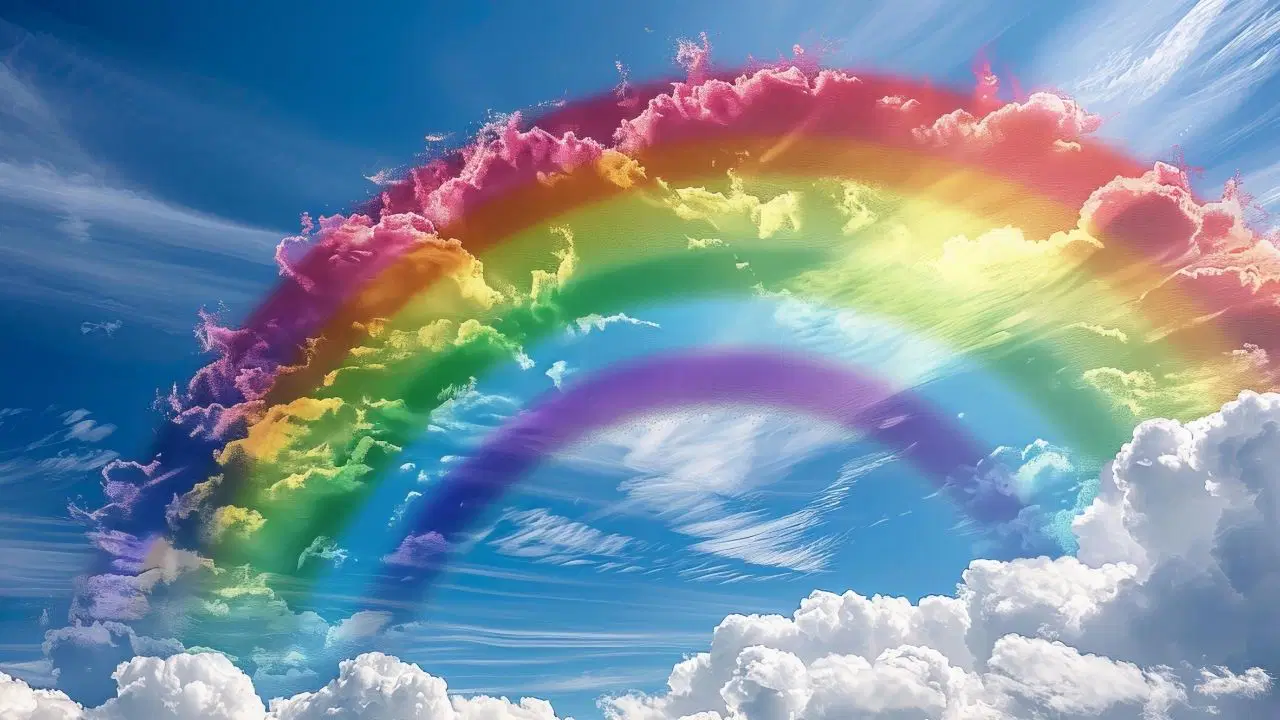
Why do the rainbows everyone sees look different?
Translated from Turkish, summarized and contextualized by DistantNews.
At a glance
Explainer
Named sources
Context piece
- Rainbows appear different to each observer because they are optical illusions, personalized by our eyes and perspective.
- Light refracts and reflects within raindrops, splitting into colors, with red light exiting at about 42 degrees and blue light at 40 degrees.
- The specific angle at which light reaches your eyes from different raindrops determines the colors you see, with red typically on the outer edge and blue on the inner edge.
While you and a friend might gaze at the same rainbow, the colors you perceive are uniquely yours. Rainbows are not physical objects but rather personalized optical phenomena, shaped by the light's interaction with raindrops and your specific viewpoint.
A rainbow is a pattern formed when sunlight – white light – reflects and refracts off millions of raindrops in the sky.
Physicist Philip Laven explains that a rainbow is a pattern formed when sunlight refracts and reflects off millions of raindrops. For a rainbow to appear, the sun must be behind you, with rain in front, and unobstructed sunlight. As light enters a raindrop, it slows and bends, a process called refraction. Different colors, or wavelengths, bend at slightly different angles, separating the white light into its constituent colors. This light then reflects off the back of the raindrop and refracts again as it exits, further dispersing the colors.
Light slows down and bends when it hits a raindrop. This is called refraction. The different colours – or wavelengths – of light bend by slightly different amounts, so white light is split up into all its component colours.
The key to the unique appearance lies in the angles. Red light exits a raindrop at approximately 42 degrees relative to the incoming light, while blue or violet light exits at about 40 degrees. When you look up, raindrops higher in the sky might bend red light at the precise angle to reach your eyes, while the blue light from those same drops passes over you. Conversely, raindrops lower down might direct blue light to your eyes. This is why red is typically seen on the rainbow's outer edge and blue on the inner edge.
Red light exits at about 42 degrees from where the original light entered, while blue or violet light exits at about 40 degrees.
Rainbows form a circle around a point called the antisolar point, which is the center of your shadow. However, the lower part of the circle is usually hidden by the ground. The lower the sun is, the more of the circle you can see. If the sun is more than 42 degrees above the horizon, the entire rainbow, even its peak, will be below ground level, which is why rainbows are rarely seen in the middle of the day. Even slight changes in your position, or your friend's, relative to the raindrops would alter the angle at which the light reaches your eyes, making your rainbow subtly different from theirs.
If the sky between you and the rainbow is a bit clear, you might see a secondary rainbow.
DistantNews Editorial
Originally published by Cumhuriyet in Turkish. Translated, summarized, and contextualized by our editorial team with added local perspective. Read our editorial standards.
More Stories



From Our Blog

What Gets Lost (and Found) When News Is Translated

The Critical Role of Diaspora Media in Global News

What Travellers Should Know About Countries with Restricted Press

A Digital Nomad's Guide to Following Local News

How the Same Story Looks Different in Different Countries
