


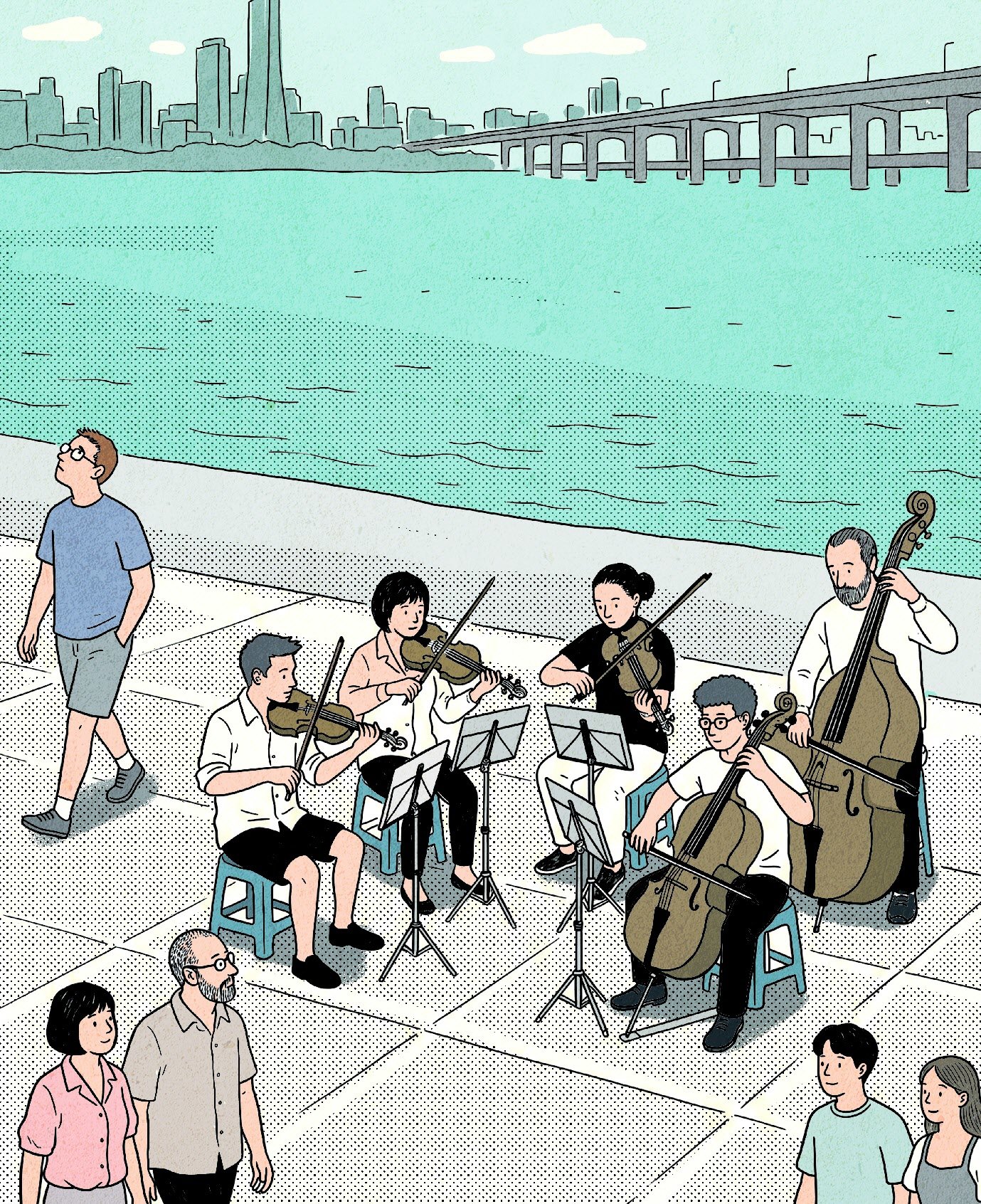
Why the World's Best Orchestras Are Performing Outside the Concert Hall
Translated from Korean, summarized and contextualized by DistantNews.
At a glance
In-depth
Sources not specified
Context piece
- World-class orchestras are increasingly performing outside traditional concert halls, taking music to the people.
- Events like the Berlin Philharmonic's open-air concert in Berlin's Waldbühne and the Vienna Philharmonic's summer night concert at Schönbrunn Palace have become major city festivals.
- This trend suggests that great cities are defined by more than just their performance venues; they are places where music actively seeks out its audience.
When people think of classical music, concert halls often come to mind first: the high ceilings, red seating, and formally dressed musicians on stage. For a long time, classical music was perceived as an art form intrinsically tied to these specific spaces.
Indeed, many compositions were written with the acoustics of performance halls in mind, and the optimal musical experience is still often achieved in a well-designed venue. However, a curious trend is emerging among the world's top orchestras: they seem to have a particular fondness for performing beyond the confines of these traditional spaces.
It is often the ensembles with access to the finest concert halls that are most eager to venture outside. Rather than waiting for audiences to come to them, these musicians are taking their music directly to the people. This approach suggests a deep understanding that a city's greatness is not solely measured by the quality of its concert halls.
Each summer, tens of thousands gather at the Waldbühne, an open-air amphitheater in the forests of Berlin, for the Berlin Philharmonic Orchestra's outdoor concert, which has become a significant city festival. Similarly, the Vienna Philharmonic Orchestra's summer night concert at Schönbrunn Palace transforms the palace gardens into a stage, drawing in both citizens and tourists alike. These events demonstrate a commitment to making classical music accessible and integrating it into the broader urban experience.
DistantNews Editorial
Originally published by Dong-A Ilbo in Korean. Translated, summarized, and contextualized by our editorial team with added local perspective. Read our editorial standards.
More Stories



From Our Blog

What Gets Lost (and Found) When News Is Translated

The Critical Role of Diaspora Media in Global News

What Travellers Should Know About Countries with Restricted Press

A Digital Nomad's Guide to Following Local News

How the Same Story Looks Different in Different Countries
