


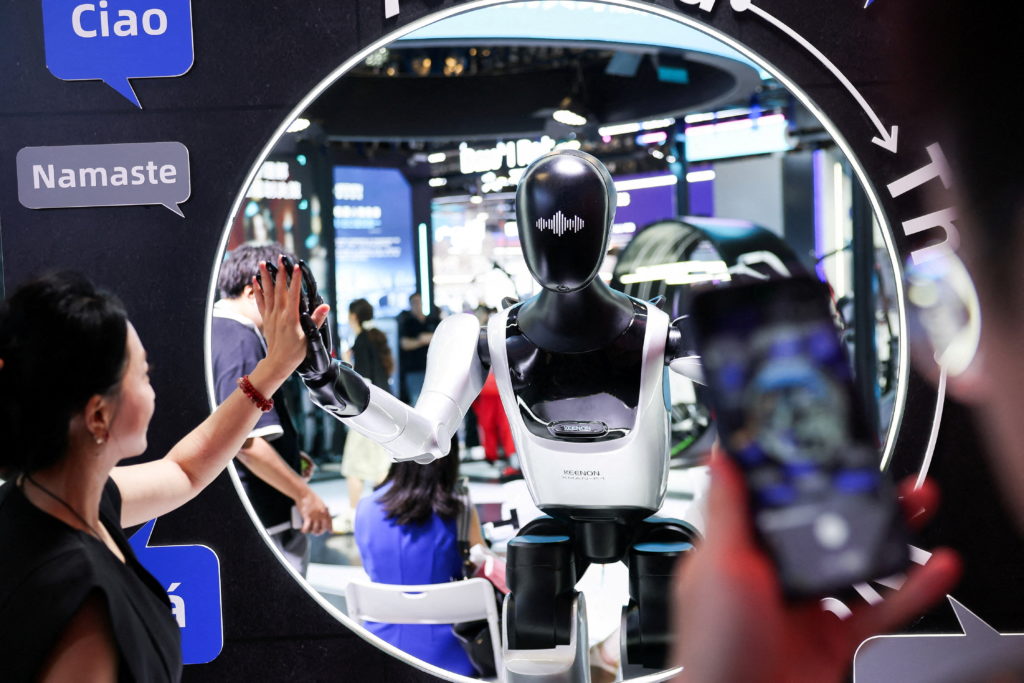
Workers in China worry over being replaced as they adapt to the growing impact of AI on jobs
Summarized and contextualized by DistantNews.
At a glance
News
From a news agency
Ongoing story
- Chinese computer programmer Fei Zhaojun was laid off with 160 colleagues after his boss questioned AI's ability to replace coders.
- China is rapidly adopting AI, supported by government policies, leading to job displacement and fear across various sectors.
- Workers like Fei are adapting by exploring AI-enabled businesses or creating content, while others, like translators, see reduced pay despite temporary work training AI models.
The growing impact of artificial intelligence on China's job market is causing widespread worry among workers, with many fearing replacement. Computer programmer Fei Zhaojun experienced this firsthand when he was laid off, along with about 160 colleagues, just two weeks after his boss inquired about AI's potential to take over coding jobs.
Mid-level coders' job are essentially replaceable in most of the cases.
This scenario is becoming increasingly common as China, a global economic powerhouse, rapidly integrates AI across various industries, from programming and scriptwriting to physical labor. Government policies actively encourage the adoption of AI applications and robotics, reshaping the employment landscape. Some economists caution that this rapid transformation could potentially undermine the overall strength of the world's second-largest economy.
Fei, who previously doubted AI's coding capabilities, now acknowledges that mid-level coding jobs are largely replaceable. "Even if it is a disaster that leads to replacing all humans, at this stage, you just have to use it as everyone else is using it," he stated. Currently on a career break, Fei is creating vlog-style videos about ordinary people's lives, hoping to help others navigate this transition.
Even if it is a disaster that leads to replacing all humans, at this stage, you just have to use it as everyone else is using it.
Others are finding ways to adapt, albeit with mixed results. Du Qinchun, a part-time translator, has been training AI models, which has provided temporary work. However, he noted that pay in the translation industry has been cut by more than half compared to previous years. The trend is so pronounced that popular college foreign language programs are declining in favor as AI translation tools become more prevalent. According to IDC, the share of Chinese industrial enterprises using AI models jumped to 47.5% last year from 9.6% in 2024, highlighting the swift integration of AI technologies.
But it's true that the pay in the industry has been cut by more than half compared to what it was years ago.
DistantNews Editorial
Originally published by PBS NewsHour. Summarized and contextualized by our editorial team with added local perspective. Read our editorial standards.
More Stories



From Our Blog

How the Same Story Looks Different in Different Countries

What Gets Lost (and Found) When News Is Translated

The Critical Role of Diaspora Media in Global News

What Travellers Should Know About Countries with Restricted Press

A Digital Nomad's Guide to Following Local News
