


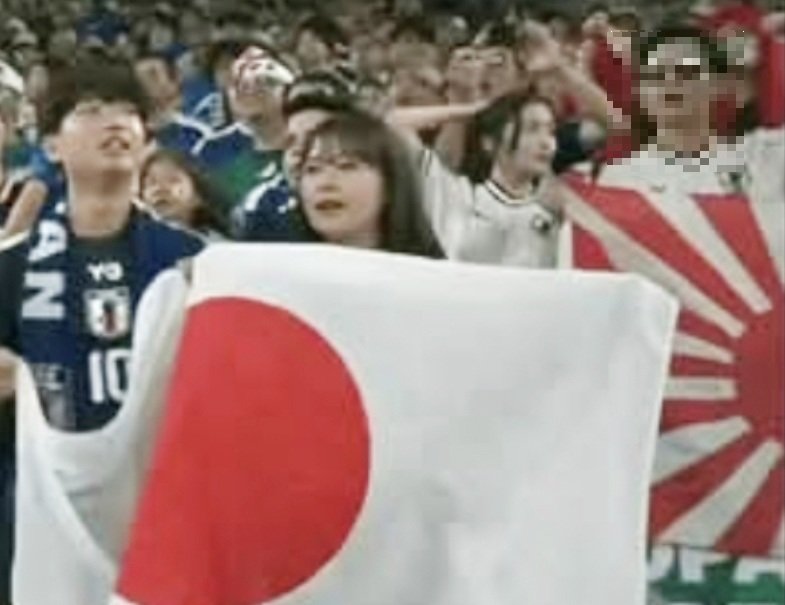
World Cup 'Rising Sun Flag' Controversy: Japanese Netizens Ask 'Why Scrutinize Our Support?'
Translated from Korean, summarized and contextualized by DistantNews.
At a glance
News
Sources not specified
Context piece
- A Japanese flag, known as the Rising Sun flag, was spotted in the crowd during Japan's World Cup match against Tunisia.
- The flag is controversial due to its association with Japanese imperialism and militarism during wartime.
- A South Korean professor plans to report the incident to FIFA, while some Japanese netizens defend the flag as a symbol of support.
A controversial Japanese flag, the Rising Sun, appeared in the stands during Japan's 4-0 World Cup victory over Tunisia, sparking debate. The flag, associated with Japanese militarism and imperialism, has drawn criticism from South Korea. Professor Seo Kyoung-duk of Sungshin Women's University in South Korea announced plans to report the incident to FIFA to prevent future occurrences.
The professor's reaction is abnormal. He says it's inappropriate just by seeing the radial design and associates it with the Rising Sun flag. We need to respond firmly to such claims.
Japanese netizens, however, largely dismissed the controversy. On Yahoo Japan News, many comments criticized the South Korean reaction. One user called the professor's response "abnormal," suggesting he sees the flag's radial design everywhere and arguing for a firm response to such claims. Another commenter stated, "We are just cheering with all our hearts," and accused the other side of bringing political ideology into sports.
We are just cheering with all our hearts. The ones who are bringing political ideology and propaganda into sports are them.
Despite the prevailing sentiment among some Japanese netizens, a dissenting voice acknowledged the flag's political connotations. "Since the use of the Rising Sun flag has already taken on political meaning, we must be careful," one comment read. "We cannot simply say it is okay."
The use of the Rising Sun flag has already taken on political meaning, so we must be careful. We cannot simply say it is okay.
DistantNews Editorial
Originally published by Dong-A Ilbo in Korean. Translated, summarized, and contextualized by our editorial team with added local perspective. Read our editorial standards.
More Stories



From Our Blog

What Gets Lost (and Found) When News Is Translated

The Critical Role of Diaspora Media in Global News

What Travellers Should Know About Countries with Restricted Press

A Digital Nomad's Guide to Following Local News

How the Same Story Looks Different in Different Countries
