


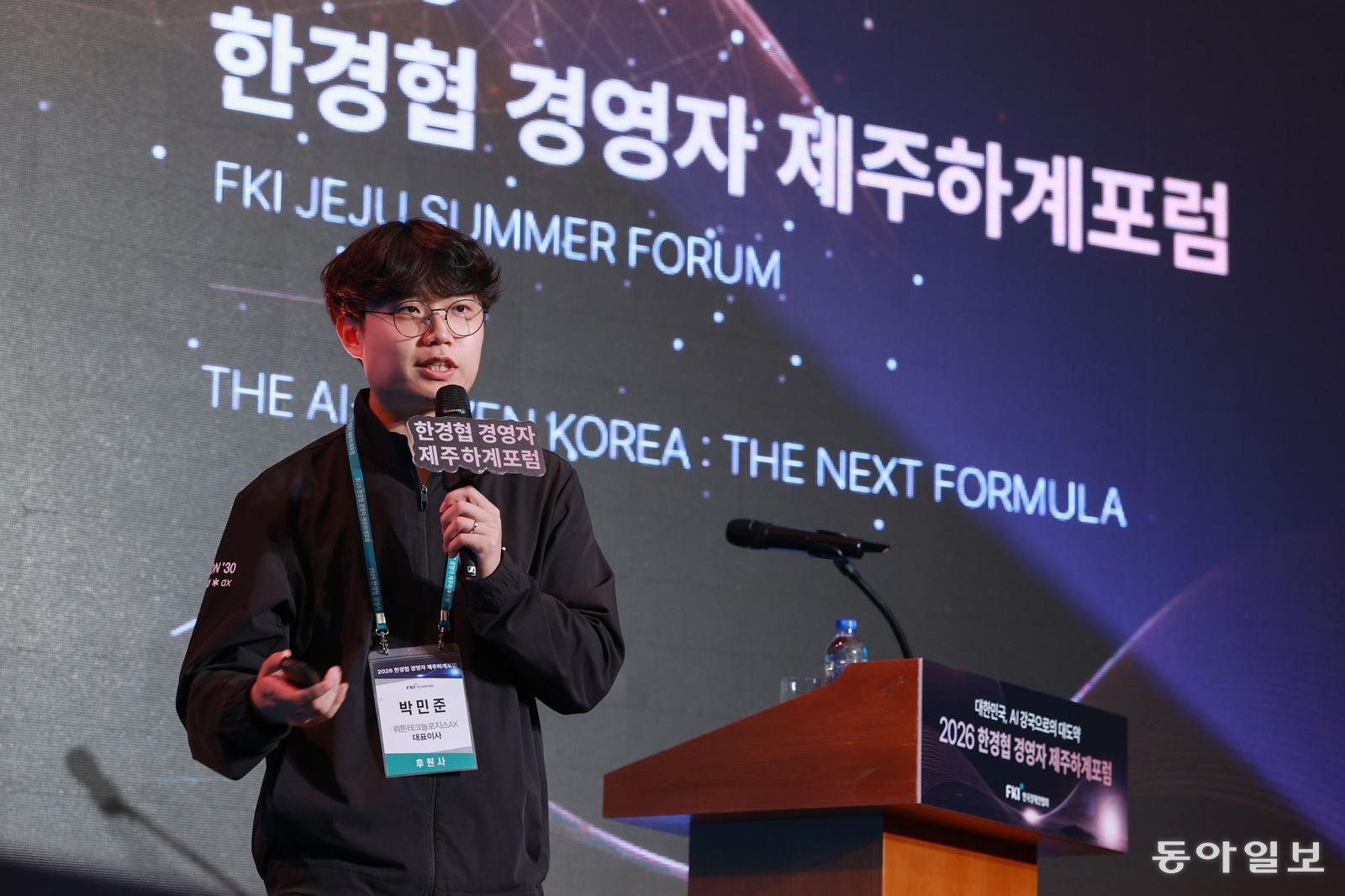
Wrtn CEO Park Min-jun: 'We will replace management with AI'
Translated from Korean, summarized and contextualized by DistantNews.
At a glance
News
Sources not specified
New plan
- Park Min-jun, CEO of Wrtn Technologies, aims to replace company executives with AI within the next year.
- He is experimenting with AI agents for various roles, including product development, marketing, and public relations, to make final decisions.
- Park emphasizes that successful AI integration requires preparing company data and organizational structures for AI utilization, comparing it to laying railway tracks before a train arrives.
Park Min-jun, CEO of Wrtn Technologies, declared his ambitious goal: to replace company executives with artificial intelligence within the next year. He shared this vision during the '2026 HIRA Management Jeju Summer Forum' held at the Lotte Hotel in Jeju.
Park is currently experimenting with a novel approach where AI agents, each specializing in roles like product development, marketing, and public relations, engage in discussions. He then synthesizes their input to make the final executive decisions. "The era where AI agents with expertise gather, work, and even make decisions is coming soon," he stated.
He elaborated on his "AI technology adoption was easy, but companies' AI transformation did not happen" lecture, detailing his ongoing experiment to replace management with AI. Initially, he found AI's capabilities beneficial, but after a month, verifying AI's responses became more time-consuming. He also noted that while AI is intelligent, it sometimes struggles with context or becomes confused.
To address this, Park's company developed role-specific AI agents. These agents debate and present opinions, which Park then consolidates for final decisions. He likens AI to a "smart new employee," emphasizing that even advanced AI cannot function effectively without understanding a company's work methods, data, and organizational culture. "A new employee cannot perform at full capacity immediately; they need adaptation and training," he explained. "AI also needs to thoroughly learn the company's context to work properly."
Park predicts a future where organizations are operated collaboratively with AI, rather than humans simply using AI. He stressed the importance of systematically organizing company information so AI can utilize it immediately upon integration. "If it's clear that the train is coming next year, it's natural to lay the railway tracks this year," he said. "As AI is becoming the trend, the most important task this year is organizing and connecting company data so AI can utilize it."
This involves converting scattered data, such as internal documents, systems, and files, into a format readable by AI and establishing a system for conceptualizing this data. Park concluded by stating that from next year, AI agents that directly operate computers will be widely distributed. "Competitiveness in the AI era will depend not on how much AI has been adopted, but on how well data and organizations have been prepared for AI to work," he asserted.
DistantNews Editorial
Originally published by Dong-A Ilbo in Korean. Translated, summarized, and contextualized by our editorial team with added local perspective. Read our editorial standards.
More Stories



From Our Blog

What Gets Lost (and Found) When News Is Translated

The Critical Role of Diaspora Media in Global News

What Travellers Should Know About Countries with Restricted Press

A Digital Nomad's Guide to Following Local News

How the Same Story Looks Different in Different Countries
