

WWI Soldier's Postcard Reunites Family After a Century
Translated from Romanian, summarized and contextualized by DistantNews.
At a glance
In-depth
Named sources
Outcome reported
- A postcard found on the remains of a British soldier from World War I helped reunite his family with distant relatives a century later.
- The soldier, Thomas Whitaker, was identified through archival research and DNA analysis after his remains were discovered in Belgium.
- The postcard, originating from his hometown of Bradford, England, proved crucial in establishing his identity and connecting his family to descendants.
A century after his death on the Western Front, a British soldier's final message home has facilitated a family reunion. The remains of Thomas Whitaker, who died during World War I, were recently discovered alongside five comrades during an archaeological dig in western Belgium.
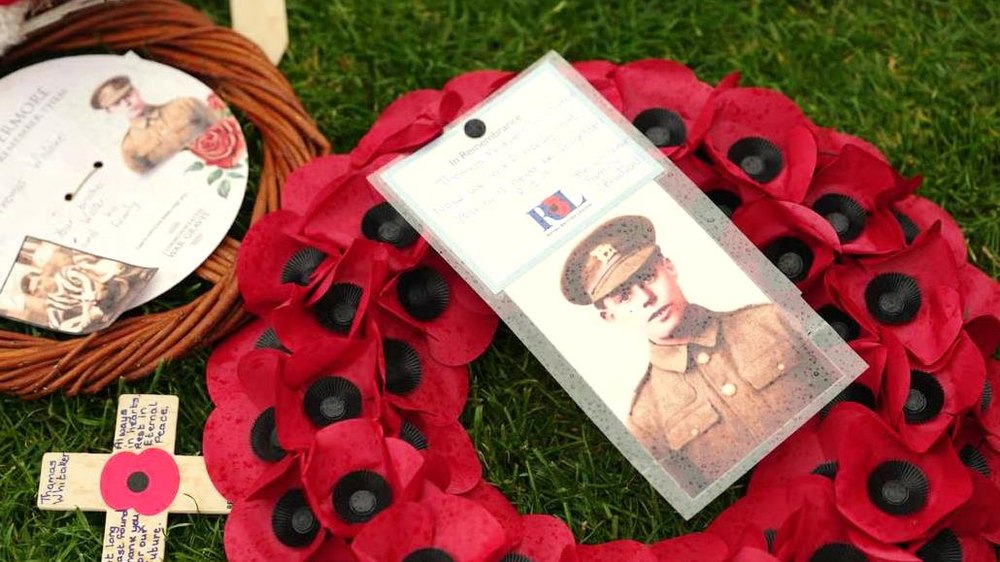
Six new white marble headstones were unveiled at the Tyne Cot Cemetery in a memorial service attended by three of Whitaker's descendants. Young Joe Whitaker, 22, read a poem honoring his great-great-uncle, reflecting on his final thoughts: "In peace, on foreign hills, he finally slumbers, with thoughts of Bradford mills."
The thought that (Thomas) might have been thinking of home, comforted by this postcard from Bradford that he was holding onto – that surprised us all quite a bit.
The key to identifying Whitaker and connecting his living relatives was a postcard found in his possession. This artifact from Bradford, England, where some of his family still resides, proved instrumental for British government researchers. "The thought that (Thomas) might have been thinking of home, comforted by this postcard from Bradford that he was holding onto – that surprised us all quite a bit," Joe Whitaker shared, adding that writing the poem felt like the right tribute.
Alexia Clark, a commemoration specialist from the UK Ministry of Defence's Joint Casualty and Compassionate Centre (JCCC), described the postcard as a crucial "clue." The JCCC, known as "war detectives," cross-referenced the postcard with other artifacts like a Lewis gun and uniforms. By correlating these findings with lists of missing soldiers, they identified Whitaker as a likely candidate from Bradford among the over half a million British soldiers still unaccounted for from the war. DNA analysis later confirmed his identity, along with five other soldiers: Horace Frederick Cook, Frederick Martin, Charles Richard Russels, Courtney Darvill Hart, and Joseph Turnley, all from the 2nd/4th Battalion of the Queen’s Royal West Surrey Regiment.
And then, when we looked at the list of the missing and realised: 'Oh, we have one from Bradford! Brilliant, there's a good chance he could be one of them.'
DistantNews Editorial
Originally published by Adevărul in Romanian. Translated, summarized, and contextualized by our editorial team with added local perspective. Read our editorial standards.
More Stories
From Our Blog

What Gets Lost (and Found) When News Is Translated

The Critical Role of Diaspora Media in Global News

What Travellers Should Know About Countries with Restricted Press

A Digital Nomad's Guide to Following Local News

How the Same Story Looks Different in Different Countries
