


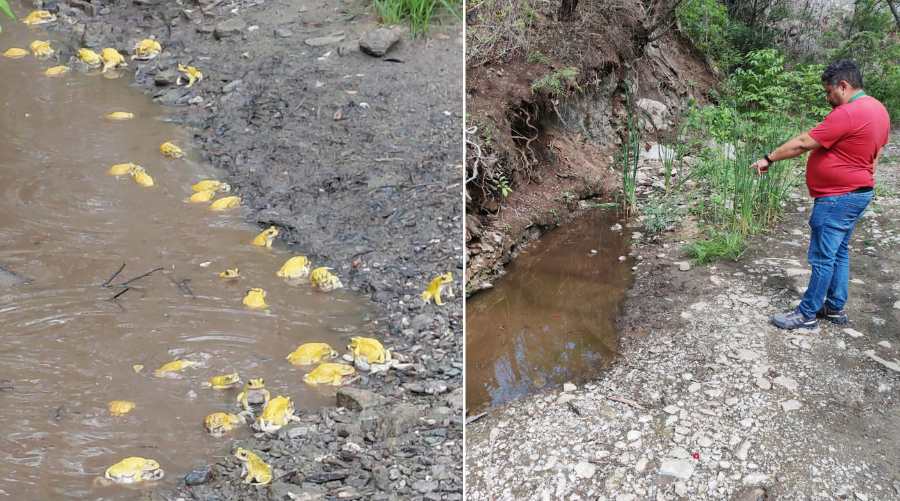
Yellow toad's appearance in Zacapa explained by Conap as natural phenomenon linked to rains
Translated from Spanish, summarized and contextualized by DistantNews.
At a glance
News
Official statement
Context piece
- Residents in Zacapa, Guatemala, observed the appearance of the yellow toad, prompting curiosity and online discussion.
- The National Council of Protected Areas (Conap) identified the species as Incilius luetkenii, a native amphibian important to local ecosystems.
- Conap explained that the toad's emergence is a natural phenomenon linked to the start of the rainy season and its reproductive cycle.
The sudden appearance of the vibrant yellow toad in Zacapa, Guatemala, has captured the attention of locals and social media users, sparking curiosity and discussion. Images of the striking amphibian, initially mistaken for a frog, began circulating from a village in Río Hondo, Zacapa, generating numerous reactions.
The National Council of Protected Areas (Conap) has identified the species as the yellow toad, Incilius luetkenii. This native amphibian plays a crucial role in the ecosystems of the Motagua Valley. Conap clarified that the toad's emergence is a natural occurrence, directly associated with the onset of the rainy season.
According to Conap's technical explanation, these amphibians emerge from a period of estivation, a state where they remain buried during the dry season to prevent dehydration. Their reappearance typically coincides with the first significant rains of the year, marking the beginning of their reproductive phase. Adult toads gather in temporary pools formed by rainfall, where males vocalize to attract females for mating, a process that also influences their coloration.
Conap emphasizes the ecological importance of the Incilius luetkenii, noting its contribution to the natural control of insects and pests. It also serves as an indicator of ecosystem health and water availability in rural areas. The recent sightings in Río Hondo are considered a natural signal of the transition into the rainy season, highlighting the need to conserve the temporary water bodies essential for this species' reproduction.
Its presence recent in Río Hondo, Zacapa, is considered a signal natural of transition towards the rainy season and highlights the importance of conserving the temporary water bodies where this species reproduces.
DistantNews Editorial
Originally published by Prensa Libre in Spanish. Translated, summarized, and contextualized by our editorial team with added local perspective. Read our editorial standards.
More Stories



From Our Blog

What Gets Lost (and Found) When News Is Translated

The Critical Role of Diaspora Media in Global News

What Travellers Should Know About Countries with Restricted Press

A Digital Nomad's Guide to Following Local News

How the Same Story Looks Different in Different Countries
