


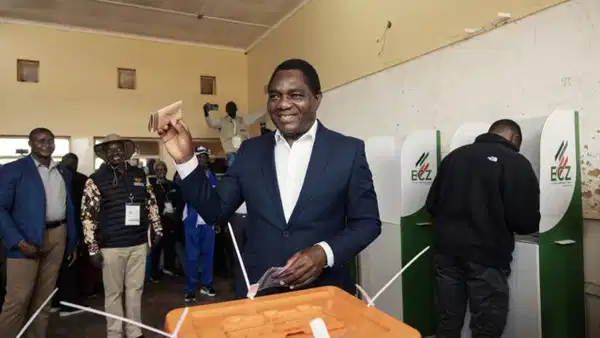
Zambia: Post-election political pressure as Hichilema begins second term amid controversy
Translated from Turkish, summarized and contextualized by DistantNews.
At a glance
Analysis
Named sources
New plan
- Hakainde Hichilema was re-elected president of Zambia with 60.49% of the vote in the August 13 general election.
- Despite the official announcement, concerns persist regarding democratic standards and the space for opposition under Hichilema's administration.
- An analysis suggests Hichilema's government has increased control over state institutions and intensified pressure on political rivals, particularly ahead of the 2026 elections.
Zambian President Hakainde Hichilema has secured a second term in office, officially declared the winner of the August 13 general election with 60.49% of the vote by the Electoral Commission of Zambia. However, the election process and its aftermath have reignited debates about the country's democratic standards and the shrinking space for opposition.
An analysis published in The Lead highlights growing concerns that Hichilema's administration has consolidated control over state institutions in recent years. This trend, the analysis suggests, has been accompanied by increased pressure on political rivals, particularly in the lead-up to the 2026 elections. Reports from within Zambia indicate a prevailing atmosphere that is not encouraging for individuals, families, or political groups not aligned with the ruling ecosystem.
Hichilema, facing the possibility of defeat in August 2026 due to a weakened economy and a country deeply divided along ethnic-regional lines, resorted to lawfare to weaken political opponents and secure his re-election.
International observers and democracy advocates have expressed significant concern over alleged violations and illegal actions occurring both before and during the election period. These concerns are reportedly continuing even after the election results were announced. The situation has led to widespread unease, uncertainty, and anxiety among many citizens of the southern African nation.
According to the analysis, Hichilema's administration has employed a strategy over the past four years to centralize power within specific groups. Political analyst Sishuwa Sishuwa describes this as a "lawfare" strategy, initiated when Hichilema faced the possibility of defeat in August 2026 due to a weakened economy and a country deeply divided along ethnic-regional lines. Sishuwa argues that Hichilema resorted to "lawfare" to weaken political opponents and secure re-election, utilizing key institutions like the judiciary, police, parliament, the election commission, and public administration.
the president developed specific strategies using five key institutions for this latest wave of legal authoritarianism: the judiciary, the police, parliament, the election commission, and public administration.
DistantNews Editorial
Originally published by Cumhuriyet in Turkish. Translated, summarized, and contextualized by our editorial team with added local perspective. Read our editorial standards.
More Stories


From Our Blog

What Gets Lost (and Found) When News Is Translated

The Critical Role of Diaspora Media in Global News

What Travellers Should Know About Countries with Restricted Press

A Digital Nomad's Guide to Following Local News

How the Same Story Looks Different in Different Countries
