


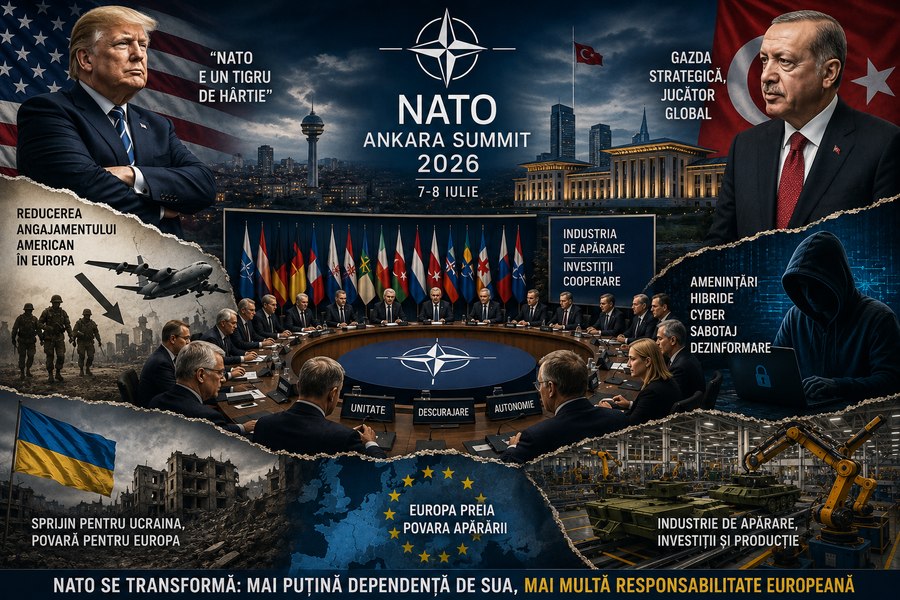
Ankara 2026: NATO Summit Pivotal for Alliance's Future
Translated from Romanian, summarized and contextualized by DistantNews.
At a glance
News
Sources not specified
Context piece
- NATO's 2026 Ankara summit focuses on political unity, European rearmament, and burden-sharing amid US uncertainty.
- The alliance faces five major challenges: unpredictable US leadership, persistent Russian military threat, European security responsibility, US-EU divergence on Middle East conflicts, and hybrid warfare.
- The summit's success hinges on maintaining cohesion rather than achieving new initiatives, as the alliance adapts to a changing geopolitical landscape.
The 2026 NATO summit in Ankara convenes at a critical juncture, with the alliance's future hinging on political unity and European self-reliance. The choice of Ankara, hosted by Recep Tayyip Erdoğan, a leader known for navigating between the West and other spheres, underscores the complex geopolitical balancing act NATO faces.
the art of being simultaneously inside and outside the West
Leaders are set to reaffirm their commitment to collective defense and the transatlantic bond. However, this commitment is tested by the unpredictable stance of US President Donald Trump, who has previously questioned NATO's value and the US commitment to its defense. His potential return to power casts a shadow over the alliance's security guarantees.
NATO confronts five significant challenges. Russia remains a primary military threat, rebuilding its forces despite the ongoing war in Ukraine. As the US potentially scales back its military presence in Europe, European nations must shoulder more responsibility for their own security, raising questions about leadership and influence within the alliance. Divergent views between the US and European allies on conflicts, such as the one involving Iran, have also strained political trust.
paper tiger
Furthermore, NATO must adapt to evolving threats like cyberattacks, sabotage, disinformation, and the growing alignment between Russia and China. The summit's success will be measured not by grand new strategies, but by its ability to prevent the erosion of existing commitments and maintain solidarity in a rapidly shifting global security environment.
The bar, therefore, could not be lower. Success in Ankara today is measured not by what will be built, but by what will not be demolished.
DistantNews Editorial
Originally published by Adevărul in Romanian. Translated, summarized, and contextualized by our editorial team with added local perspective. Read our editorial standards.
More Stories
From Our Blog

What Gets Lost (and Found) When News Is Translated

The Critical Role of Diaspora Media in Global News

What Travellers Should Know About Countries with Restricted Press

A Digital Nomad's Guide to Following Local News

How the Same Story Looks Different in Different Countries
